
Self Learning Workflows Defining the Future of Collateral Reconciliation and Counterparty Confidence
Quick answer
Self-learning workflows in collateral reconciliation significantly reduce manual errors, speed up processing, and enhance counterparty confidence by automating routine checks and adjustments. Such AI workflows for collateral reconciliation adapt over time, continuously enhancing precision and reliability in counterparty reconciliation.
Look, everyone in finance has battled the chaos of quarterly reconciliations. It's a relentless parade of mismatched entries and error-laden spreadsheets. You're constantly juggling partner anxieties and overflowing email demands. Each unchecked discrepancy isn’t just a number, it’s a ding in your counterparty relationship. And just like that, trust begins its downward spiral.
This isn’t an anomaly for a select few; it's the daily grind for many. Manual processes have locked teams into cycles of redundancy, siphoning time and sanity. It's a risky, inefficient mess. And until recently, that was status quo. But let's be real, salvation is here, and it's self-learning AI. We've reached the juncture where these systems don't just assist; they take the wheel.
In my experience, I've sat through countless claims of revolutionary tech changes. Nine times out of ten, it’s been smoke and mirrors. But AI workflows are the transformation we've been promised. These aren't your average automated processes. They're evolving, learning, and ready to change the landscape of collateral reconciliation. It's not hype, it's the new reality.
Understanding Collateral Reconciliation with AI
Here’s the thing: collateral reconciliation doesn’t have to be a nightmare. AI workflows for collateral reconciliation can automate many of the cumbersome manual tasks, making the reconciliation process smoother and far less prone to human error. This process isn’t just about ticking boxes; it’s about improving accuracy, speed, and transparency.
Manual Collateral Reconciliation Processes:
• Labor-intensive reconciliation requires manual cross-checking, often leading to exhaustion and burnout.
• Human error rates are inconsistently high, with some reports showing errors in one out of every five entries.
• Spreadsheets balloon in size, complicating audits and generating a logistical nightmare for compliance.
• Verification delays occur often, as communication gaps between departments lead to misaligned priorities.
• Companies frequently incur hefty penalties due to late or incorrect reporting caused by manual errors.
• Analyst bias influences data interpretation, resulting in costly misjudgments and inconsistent reports.
• Scaling processes to handle increased transaction volumes stretches resources thin, affecting overall efficiency.
AI-Optimized Collateral Reconciliation:
• Self-learning AI’s capacity for repetitive data tasks dramatically reduces error margins, achieving near-zero discrepancies.
• With improvements over time, machine learning slashes reconciliation times by up to 70%, bringing speed and efficiency.
• These systems handle substantial data with ease, offering unmatched scalability and reliability for growth.
• AI workflows provide real-time data processing, significantly cutting down on lag and preventing backlog build-ups.
• Automating routine verification can lead to a 50% reduction in personnel costs tied to manual interventions.
• The transparency AI provides strengthens counterparty trust, as updates become more accurate and timely.
• Less manual intervention frees up personnel to engage in strategic endeavors, boosting morale and innovation potential.
The Part Nobody Budgets For: Collateral Reconciliation Hidden Costs
Let’s talk about an unspoken truth: the hidden costs of inefficient collateral reconciliation processes are killing your bottom line. Most enterprises don’t budget for the long-term impacts of outdated systems, until the hemorrhaging is too obvious to ignore. It’s time to stop sweeping this under the rug.
Each unresolved mismatch in collateral reporting isn't merely a data blip; it’s a crack in the credibility of your financial statements. The worst part is, these little cracks compound over time, eroding counterparty confidence and increasing scrutiny from auditors. The direct costs of errors may seem minor at first glance, but over time, they lead to massive write-offs and delayed project timelines.
Moreover, the soft costs, like wasted labor hours and the potential loss of creditor trust, are often underestimated. Compounded misconceptions about risk lead to over-leverage or under-leverage, depending on your appetite and risk assessment ability. Business decisions stalled just because the historical data was never reliable enough for meaningful insights? Yeah, that happens more often than you’d think.
AI Workflow Steps in Collateral Reconciliation
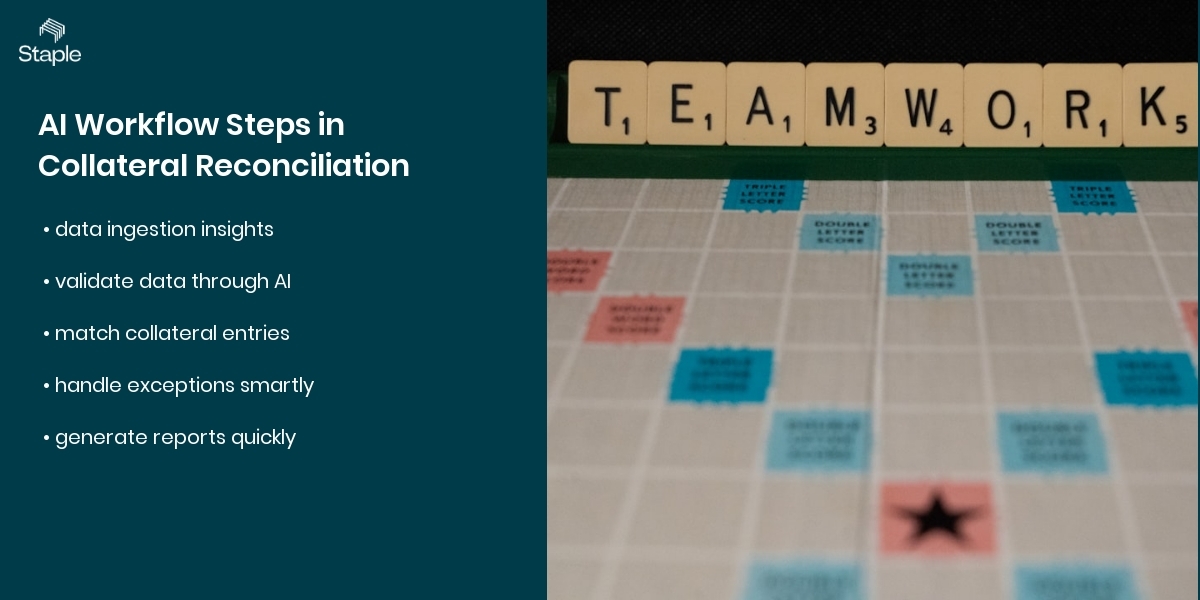
Step 1: Data Ingestion. In this initial step, AI captures and digitizes data from varied sources. A self-learning AI system scans financial documents and entries for data extraction with accuracy that manual methods can't match. The output is a digital database that forms the backbone for analysis.
Step 2: Data Validation. AI algorithms cross-verify the ingested data against established benchmarks and prior records. The system highlights discrepancies, which are either flagged for review or auto-corrected based on historical learning. This results in a more reliable database for subsequent steps.
Step 3: Matching Entries. Here, self-learning workflows match transactions and collateral consistently using predetermined rules enhanced over time by machine learning. As a result, mismatched entries are flagged or auto-corrected, reducing errors and streamlining processes.
Step 4: Exception Handling. Any issues or discrepancies that could not be auto-corrected are earmarked for specialist review. AI-driven insights provide context to human operators for faster decision-making. This decreases the time taken to resolve exceptions, ensuring smoother operations.
Step 5: Report Generation. After handling all exceptions, the AI system generates comprehensive reports for stakeholders. These reports provide a consolidated view, improving managerial insights and decision-making. Continuous data acumen ensures reports are not only accurate but also focused on actionable insights.
What Nobody Tells You: The Real Implementation Challenges

Data Incompatibility. Most legacy systems aren’t prepared for the data formats AI requires, which can stall integrations. Vendors often gloss over this, pitching the ease of AI without honest discussions about existing system upgrades.
Change Management. Implementing AI means changing your workflow, valuable time is lost when teams resist or misunderstand new operations. Vendors tend to skip over the human resistance factor focusing instead on the tech aspect only.
Initial Costs. The upfront investment required for AI integration is a challenge, particularly if savings are only realized over time. Often, vendors understate these initial costs while over-promising supposed quick ROI.
AI's Role in Transforming Document Automation

Let’s break it down. Implementing AI workflows for collateral reconciliation fundamentally alters how financial teams operate. No longer are they tied up in manual data entry and cross-verifications. Instead, AI handles these tasks, enabling teams to focus on strategic operations and decision-making processes. This is real transformation.
Self-learning AI continuously adapts and learns, refining its algorithms to keep processes efficient and accurate. For example, AI-driven automatic reconciliation detects anomalies faster than traditional methods, and it provides insights to mitigate risks before they become costly problems. The future of collateral matching automation, as a result, isn't just about speed. It’s about precision and reliability, which translates into increased counterparty confidence.
For example, Staple AI offers a suite of products that harness these AI capabilities effectively. By automating mundane tasks and cutting down on manual processes, companies save time and reduce the risk of errors. Not only do these workflows streamline operations, but they also clear a path for growth by building stronger, more trusting relationships with counterparties.
Counterparty Trust Benchmarks: Research and Analysis
According to the Gartner 2024 Finance AI Adoption Survey, 58% of finance functions were using AI in 2024. This is a clear indicator that AI for improving counterparty trust is not just in the future but happening now. Those not adopting these technologies will soon find themselves playing catch-up.
Moreover, Ardent Partners’ report revealed that companies using AI saw a 77% straight-through processing rate in their AP departments versus just 34% for standard operations. This demonstrates the efficiency gains AI workflows bring to the table.
Additionally, research by Grand View Research forecasts the global AP automation market to reach $7.1 billion by 2030. The momentum is building, and for good reason: automation consistently supports growth.
Finally, a stark comparison is found in ACFE’s 2024 report, which states that organizations lose 5% of their annual revenue to occupational fraud. Reducing such vulnerabilities through automated reconciliation is not just beneficial; it’s necessary.
Frequently Asked Questions
Why is collateral reconciliation important for enterprises?
Collateral reconciliation ensures that the financial records of a company match the statements held by its counterparties. This process is critical for maintaining transparency and trust. Ensuring that the data aligns mitigates financial risks and supports strategic decision-making, preventing discrepancies from impacting business operations and relationships.
How does AI improve counterparty reconciliation?
AI significantly enhances counterparty reconciliation through automated data handling, validation, and anomaly detection. Self-learning models continuously refine processes to deliver more reliable and accurate data. By removing human error and increasing efficiency, AI significantly improves accuracy and builds trust between businesses and their counterparties.
What are the potential risks of not implementing AI workflows?
Relying on manual processes increases the risk of human error, delays, and miscommunication, which can damage relationships with counterparties. Companies that fail to adopt AI risk losing competitive advantage, facing higher operational costs, and dealing with longer transaction cycles. The inability to keep up with financial technology trends can severely impact business growth and efficiency.
Are there downsides to using AI in collateral reconciliation?
While AI presents many benefits, the initial integration phase can be costly and complex. Data compatibility and system integration challenges may arise with existing IT infrastructure. To mitigate these challenges, it's crucial for enterprises to have clear strategies and partner with the right technology providers.
How can enterprises prepare for AI implementation?
Companies should conduct an extensive audit of their current systems to identify compatibility issues and performance gaps. Training teams and fostering a culture that embraces technological change are crucial for successful implementation. Working with experienced vendors like Staple AI can also ensure a smoother transition and long-term success in utilizing AI for collateral automation.
How Staple AI Can Help
Staple AI offers intelligent workflows that streamline collateral reconciliation through AI-driven automation. With solutions such as Intelligent Tables and Auto-Reconciliation, enterprises can eliminate manual reconciliation tasks, reduce errors, and improve operational efficiency. These solutions ensure that AI counterparty risk management is top-notch, building a strong foundation for enhanced trust and credibility.
The implementation process includes expert consultation and integration support, ensuring your systems are AI-ready without disrupting existing processes. Staple AI's team works closely with your IT department to ensure compatibility and to tailor solutions that fit your unique workflows and needs. Expect rapid scalability and precise reconciliation once these systems are up and operational.
Don't wait to modernize your reconciliation processes. Visit the Staple AI website for more information or to schedule a demo. Future-proof your operations with solutions that redefine the future of collateral reconciliation and counterparty confidence.

.png)