Our New Website Is Coming Soon!

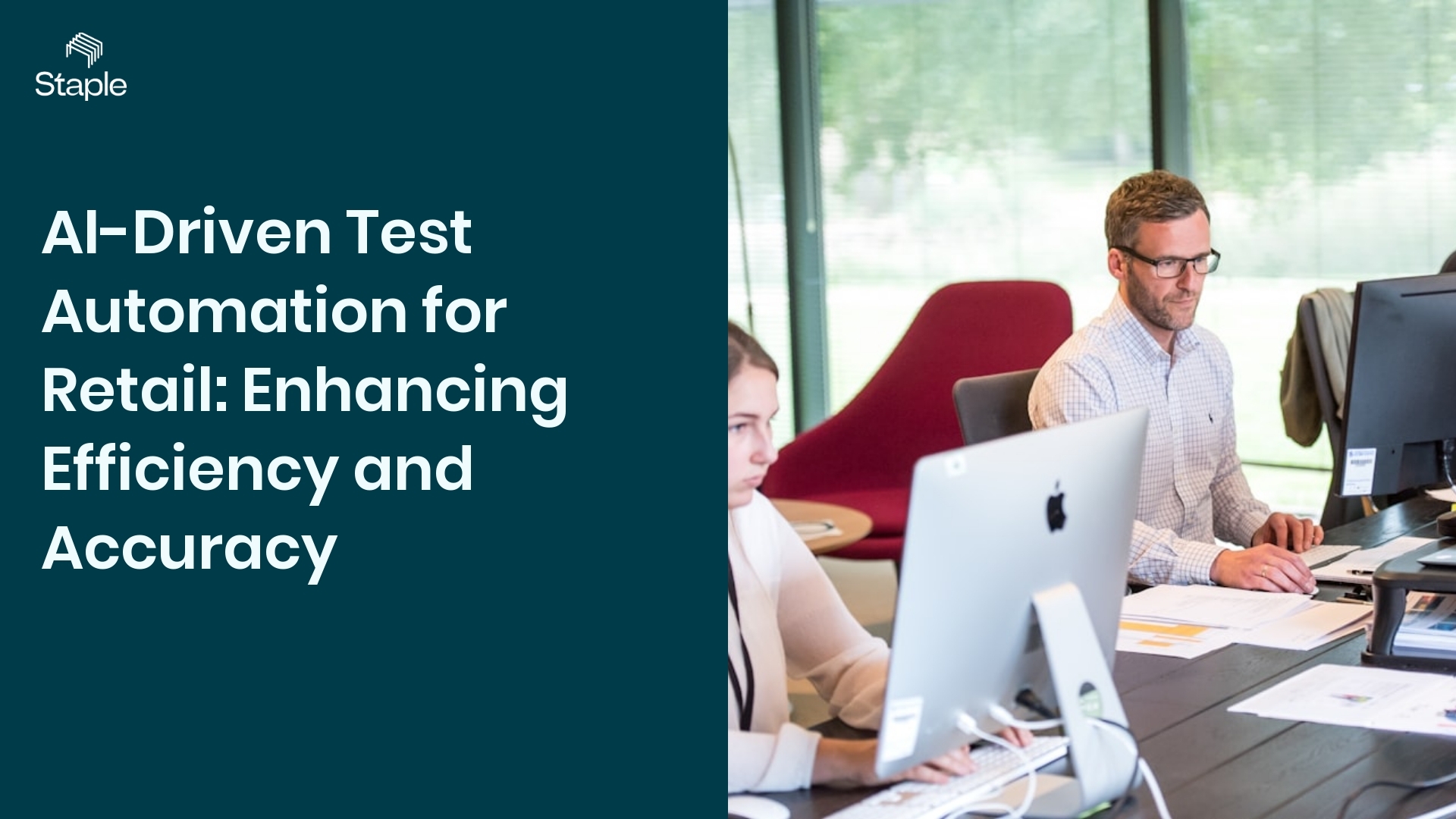
AI-Driven Test Automation for Retail: Enhancing Efficiency and Accuracy

Posted on
April 23, 2026
webhooks Staple AI
Posted by
Emily
AI-Driven Test Automation for Retail: Enhancing Efficiency and Accuracy - Staple AI

Quick answer: 

AI-driven test automation in retail enhances efficiency and accuracy by leveraging AI in DevOps to streamline processes, reduce manual intervention, and minimize errors. This enables faster testing cycles and more reliable results, freeing up resources to focus on strategic innovation.

Let’s disrupt the conventional wisdom right out of the gate: the real financial drag isn’t the cost of new technology; it’s the cost of not adopting it swiftly enough. Every CFO has endured the grueling ordeal of manual software testing phases, endless days swallowed by inefficiencies, with error lists resembling an endless scroll. The uncomfortable truth is that while the financial impact of errors explodes, your competitive posture crumbles.

Imagine executing what typically takes weeks in a matter of days. With AI-driven test automation, this isn't a pipe dream; it's the new baseline. Here’s where the discomfort should creep in: a month-long slog reduced to a streamlined set of processes, unlocking not just efficiency but strategic gain. It’s the kind of pivot that differentiates today’s market leaders from tomorrow’s case studies in obsolescence. Ask yourself, are you positioned to seize this transformation?

This is more than streamlining; it’s about rethinking your entire operational framework. As AI-driven test automation becomes intertwined with retail operations the question is no longer “if” but “how fast” can you utilize it to catapult past your legacy constraints. The competitive edge lies in how quickly you can execute this transformation.

AI Test Automation: Retail Software Testing Revolutionized

The retail sector is no stranger to technological upheaval, but AI test automation represents a seismic shift in how software testing is approached. AI augmentations have reshaped traditional testing methods, allowing for shorter development cycles, fewer bugs slipping through the cracks, and, ultimately, a more integrated experience for end-users. This section breaks down the transformation from manual testing to automated systems driven by artificial intelligence.

Manual Software Testing in Retail:

• Traditional manual testing often extends testing phases well beyond their intended timelines and depletes valuable human resources.

• Human errors and omissions are inevitable, leading to diminished customer satisfaction and increased support costs.

• The extended duration of testing cycles prevents timely software releases and competitive agility in the retail space.

• Testing teams experience heightened stress levels due to burdensome workloads and tight deadlines, impacting overall productivity.

• Business growth is stifled by manually intensive processes that increase operational costs and complexity.

• The scope of testing is inherently limited by the constrained manpower and time, leaving potential vulnerabilities unaddressed.

• Complex testing scenarios necessitate intricate manual setups, which are both time-consuming and prone to human error.

AI-Powered Software Testing Solutions:

• AI-driven test automation accelerates the testing process by facilitating continuous integration and deployment, reducing time-to-market.

• It significantly diminishes human error, enhancing the reliability and precision of retail software applications.

• Using AI, complex user scenarios can be simulated with greater accuracy and speed, aligning closely with real-world usage.

• Automation of redundant tasks liberates teams to innovate and strategically align their efforts with business goals.

• Such automation enables rapid iterations, ensuring that updates are quickly rolled out in response to market demands.

• AI-driven approaches scale effortlessly, transforming scalability from a barrier into an enabler for retail expansion.

• Using AI, organizations gain actionable insights and advanced analytics, simplifying strategic decisions and adjustments.

The Strategic Cost of Delay: What Falling Behind on AI-Driven Test Automation Means for Finance Leadership

By now, you're probably aware that emerging tech adoption rates have reached breakneck speed. If you're not on the ball with AI test automation, it's quite likely you're downright sprinting down the wrong track. Research consistently shows slow adopters face increased operational costs, bottlenecked innovation, and an eroded market position.

Take, for instance, a multilayered retail company that resisted automation and paid dearly. Not only did they face prolonged testing cycles and surging error rates, but they also saw competitors launch market-friendly updates months ahead. They witnessed a shrinking market share, a painful reminder of time spent on manual, outdated processes. Now ask yourself, how does your organization stack up?

The strategic implication here is unequivocal: fall behind, and you risk becoming irrelevant. The retail industry leaders are automating and refining their systems at a rate that seems almost relentless. In two years, the gap between early adopters and latecomers will not be a gap; it will be a chasm. Boards demand efficiency, CFOs dread inefficiencies. What side will you be on?

How Leading Enterprises Are Building This Capability: The Strategic Architecture

How Leading Enterprises Are Building This Capability: The Strategic Architecture

Step 1: Initial Assessment. The first step tackles understanding the current landscape within the retail software testing environment. A comprehensive audit is undertaken by an AI team to identify the aspects where automation could make the most significant impact. The result is a well-defined roadmap tailored to business needs.

Step 2: Technology Selection. Companies move to select advanced AI tools designed for automated testing solutions. This involves coordination between IT departments and vendors to ensure the chosen technology integrates smoothly into existing systems. The output is an effective AI infrastructure ready to augment development processes.

Step 3: Pilot Implementation. Organizations begin with pilot projects, using AI test automation within controlled segments of retail software testing. This stage focuses on testing tools under real-time pressures, ironing out kinks, and measuring performance against key metrics. Successful pilots lead to full-scale deployment decisions.

Step 4: Full-Scale Deployment. Once the pilot's success metrics are satisfied, deployment scales across networks. This involves training personnel, including quality assurance teams, to use AI in DevOps efficiently. The result? Faster, more accurate testing cycles across retail operations.

Step 5: Continuous Improvement. With AI automation fully implemented, companies engage in continuous monitoring and improvement of the systems. Regular feedback loops and analytics refine processes even further, ensuring businesses keep up with technological advancements.

Why AI-Driven Test Automation Projects Stumble

Why AI-Driven Test Automation Projects Stumble

Data Complexity. Retailers often deal with a complex web of data sources, making it a challenge to design tests that cover all scenarios. This complexity can delay initial assessments and lead to inadequate automations.

Resistance to Change. Staff accustomed to traditional methods often resist shifts to AI-driven solutions. This cultural pushback can impede progress and disrupt the integration process.

Integration Hurdles. Integrating new AI technology with legacy systems is rarely smooth. Compatibility issues can arise, leading to longer implementation times and unexpected costs.

How Staple AI Powers Retail Test Automation at Scale

How AI-Native Document Processing Eliminates Manual Data Entry

Imagine a world where routine tasks, traditionally hammered out by hand, transform into streamlined, automated actions. This is what happens when you invite AI-driven testing into your retail landscape. Suddenly, tasks like data entry associated with test documentation and scenario controls are no longer prone to human error or tedium.

At Staple AI, we've seen how implementing AI appears effortless from the outside, yet inside, it harmonizes core operations. Our AI-driven approach transforms test automation projects, reducing errors, and increasing efficiency across the board. The technology adapts in real time, offering a level of precision and speed unavailable to manual processes.

When AI-powered solutions take over the convolutions of algorithmic testing and scenario adjustments, teams redirect their efforts toward higher-level problem solving and strategy. This transition facilitates actionable insights, improves resource allocation, and ensures scalability becomes second nature. The future of retail isn't just arriving; it's here.

AI's Impact on Retail Test Automation: Authoritative Insights

It's not just theory or forward-thinking speculation; AI test automation has tangible, data-backed advantages in retail. According to Gartner's 2024 Finance AI Adoption Survey, 58% of finance functions are currently using AI tools, while 37% are specifically implementing AI for AP automation. The breadth of this adoption is clear evidence of AI's transformative impact across finance and retail operations.

The Ardent Partners study on AP Metrics revealed that best-in-class Accounts Payable (AP) departments achieve a touchless processing rate of 77%, versus 34% for typical operations. This kind of efficiency translates directly into retail software testing, where similar high-throughput, low-error processes are in demand.

Furthermore, with AI test automation incorporated, manual invoice processing costs can plummet from approximately $6.30 per invoice to about $1.45 according to the IOFM Invoice Processing Benchmarks. This reduction in cost signifies substantial savings for retailers, where testing cycles are frequent and complex.

Lastly, industry experts project the global AP automation market to grow from $3.07 billion in 2023 to $7.1 billion by 2030, based on Grand View Research data. The trajectory is clear: automated systems supported by AI are not just the future; they are a continuously expanding necessity.

Frequently Asked Questions

How does AI improve the accuracy of retail software testing?

AI enhances accuracy in retail software testing by self-learning from previous test scenarios, using that knowledge to predict bugs and errors more precisely. This adaptability means that as the software environment changes, AI remains up-to-date without the need for manual script adjustments, dramatically reducing oversight and improving end-user experience.

What is the right build vs buy framework for AI test automation?

Build vs buy is an important decision. Building in-house allows tailored solutions but can demand significant time and resource investments. Buying an off-the-shelf AI solution provides faster implementation and continuous updates. Organizations must weigh the immediacy of their needs against available resources and long-term strategic objectives to determine the best path forward.

How can I build the business case for AI test automation?

To craft a compelling business case, quantify cost savings, efficiency gains, and risk reductions AI-driven test automation can offer. Illustrate potential reductions in time-to-market for software and heightened competitive advantages. Engage stakeholders with data-driven insights demonstrating both immediate benefits and long-term strategic alignment with corporate goals.

What challenges can emerge during AI test automation integration?

Integrating AI test automation can present technical challenges like data integration and system compatibility with legacy infrastructure. It may also encounter cultural resistance within teams unaccustomed to AI tools. Addressing these through proper change management, continuous training, and flexible architecture design is crucial for seamless integration.

What role does AI play in retail DevOps?

AI acts as a catalyst in retail DevOps by automating routine testing, thus expediting the continuous delivery pipeline. It identifies error patterns early, providing developers with critical feedback for quick resolution, which results in strong software releases. AI, therefore, supports a leaner, faster development cycle structured around high reliability and reduced downtime.

How Staple AI Can Help

Staple AI is at the forefront of implementing cutting-edge AI-driven test automation solutions. Our platform empowers retail organizations by automating complex test processes, integrating seamlessly with existing frameworks, and offering real-time adaptability. With features like intelligent data processing and high-accuracy analytics, Staple AI effectively streamlines testing cycles, enhancing software reliability and performance required by retail businesses.

Implementation with Staple AI is straightforward. We begin with comprehensive AI tool selection, moving to pilot studies for validation before full-scale rollout. Our team of experts supports each step, ensuring that the technology enhances, rather than disrupts, current workflows. This strategic collaboration optimizes retail software testing with significant reductions in time and cost.

Ready to transform your retail software testing landscape? Schedule a consultation with Staple AI today and explore how AI-driven automation can drive measurable results across your retail operations. Visit us to learn more and take your first steps towards cutting-edge efficiency.

Table of contents

Reach out to us:

Thank you for reaching out! We will get in touch with you shortly
Oops! Something went wrong while submitting the form. Please try again.