
AI First Client File Management as the New Standard Under MAS and SFC Oversight
Quick answer
AI technology is rapidly becoming the backbone of client file management under the eye of MAS and SFC regulations. Transforming traditional document handling processes, AI enables accurate, efficient, and compliant storage and retrieval, crucial in the fast-evolving financial landscape of Singapore and Hong Kong.
AI First Client File Management as the New Standard Under MAS and SFC Oversight
Imagine you're at your desk, late on a Friday afternoon, staring down a mountain of client files. Each one demands precise management and impeccable compliance, especially under the keen oversight of entities like Singapore's Monetary Authority of Singapore (MAS) and Hong Kong's Securities and Futures Commission (SFC). You're practically drowning in paperwork, and manual oversight just isn't cutting it anymore. You sigh, knowing that one misplaced document could spell disaster.
This is the reality for many financial institutions grappling with client file management challenges. In my experience, when manual file handling collides with the stringent regulatory requirements mandated under these organizations, stress levels can shoot through the roof. Paper records, spreadsheets , despite our best efforts, these tools seem woefully inadequate in the face of today’s fast-paced digital demands.
This is where AI steps in as a game-changer. AI-powered file management is transforming how institutions maintain compliance with MAS and SFC, ensuring documents are not just managed but optimized for accuracy and speed. Imagine streamlining all your client records while staying one step ahead of compliance checks. With AI tools, this isn't just a possibility , it's the new standard.
Understanding AI First Client File Management
AI first approaches in client file management focus on automating and enhancing traditional processes using advanced technologies. AI tools are employed to handle vast amounts of data, ensuring compliance with MAS and SFC directives. This shift is not just about speeding up processes, but ensuring higher precision, reduced human error, and a more robust security framework.
Manual Document Management Challenges:
• Manual handling of documents is time-consuming and prone to errors.
• Compliance with MAS and SFC requires significant manual oversight.
• High risk of document misplacement or loss, which can have severe repercussions.
• The potential for human error is high, affecting data accuracy.
• Scalability is limited as data volumes grow.
• Compliance checks often delay document processing.
• Maintaining up-to-date records is resource-intensive.
AI-Powered Document Management Benefits:
• AI ensures faster processing and retrieval of client files.
• Accurate and automated compliance with MAS and SFC regulations.
• Significant reduction in human error ensures higher data integrity.
• Enhanced storage security and document access control.
• Scalability is significantly improved, accommodating larger data volumes effortlessly.
• Continuous compliance checks streamline operations and reduce delays.
• AI-driven insights enable proactive management of client documents.
How AI Compliance is Reshaping Financial Oversight
When financial records spiral out of control, regulatory repercussions are not far behind. Financial regulators like MAS and SFC demand rigorous oversight and compliance, making file management a high-stakes endeavor. Non-compliance not only attracts heavy fines but also tarnishes an institution's reputation, impacting client trust and business viability.
According to McKinsey research automating document processes could help organizations save nearly 30% annually on compliance-related costs, a statistic that illustrates just how costly inefficiencies can be. Without adapting to AI-driven management, firms can face a financial bleed, risking thousands or even millions annually.
The adoption of AI is a strategic move not just for cost savings but for competitive advantage. In a landscape where precise and rapid compliance is a necessity, failing to modernize your document management systems leaves you dangerously exposed.
How AI Solutions Process Client Files for MAS and SFC
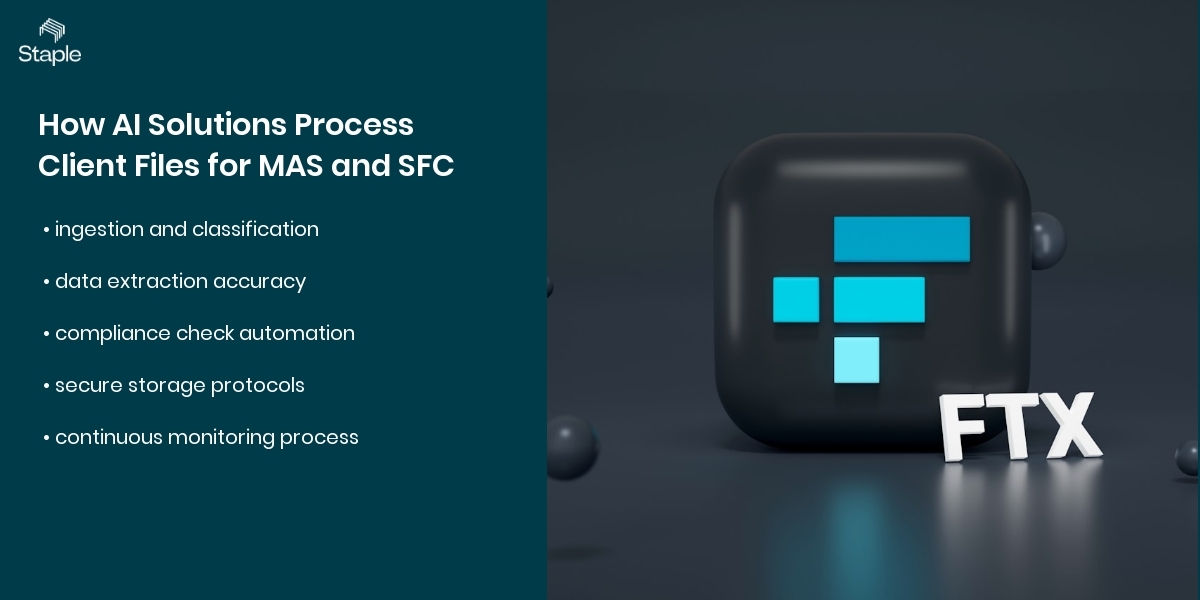
Step 1: Ingestion and Classification. AI systems ingest client documents, often PDF or scanned images, and classify them using natural language processing. This categorization is essential for maintaining organization within digital records.
Step 2: Data Extraction. Advanced technologies extract pertinent data from classified documents. Optical character recognition (OCR) ensures high accuracy, transforming unstructured data into a structured format.
Step 3: Automated Compliance Check. AI tools automatically cross-check extracted data against MAS and SFC regulations, ensuring immediate compliance verification and flagging potential issues for review.
Step 4: Secure Storage. Data is securely stored in cloud or on-premise systems, with access controls tailored to meet stringent MAS and SFC standards, ensuring both accessibility and security.
Step 5: Continuous Monitoring and Update. AI systems continuously monitor stored documents, automatically updating records as new regulatory details emerge, thus maintaining ongoing compliance.
Why AI Document Processing Projects Face Hurdles

High Initial Costs: The initial investment in AI technologies can be significant, deterring some financial institutions. This is often due to upfront hardware and software costs, which can be a barrier.
Integration Challenges: Aligning AI systems with existing infrastructure is complex. Compatibility issues may arise, requiring specialized expertise to resolve.
Data Accuracy Concerns: Despite AI's sophistication, ensuring 100% accuracy in data extraction and classification requires extensive training and adjustment over time.
Transforming Client File Management with AI Automation

AI-driven solutions fundamentally alter how client file management is tackled under MAS/SFC oversight. The transition involves transforming manual, error-prone processes into streamlined, automated workflows. This leads to operational efficiency and compliance accuracy unimaginable with traditional methods.
Staple AI for example, exemplifies how AI automation transforms financial records management. By deploying technologies that intelligently recognize, process, and store client files, institutions can mitigate risks and enhance their operational frameworks significantly. Automation replaced redundant tasks, minimized errors, and optimized compliance workflows.
Beyond reducing human workload, AI-powered file management ensures real-time compliance monitoring, which radically changes how firms stay regulatory-compliant under MAS and SFC. With AI, regulatory changes don't automatically spell operational disruptions.
Benchmarking AI Implementation in Client File Regulation
Research by Fenergo found that two-thirds of bank respondents spend between $1,501 and $3,500 per individual KYC review, with KYC representing 31, 40% of total compliance budgets at nearly one-third of surveyed banks. This reflects a vast industry shift towards digital transformation.
Gartner research indicates that organisations leveraging AI in record keeping see meaningful reductions in compliance-related incidents. This quantifies the tangible benefits of AI adoption in regulated environments.
McKinsey research highlights meaningful operational cost reductions achieved by firms integrating AI across client management processes. Such efficiency gains underscore the fiscal benefits that AI solutions provide.
Industry analysis, including research from KPMG, indicates that firms using AI technologies see meaningful efficiency increases in document processing speeds. Quick processing not only enhances compliance but elevates client service experience.
PwC research underscores AI's role in meaningfully boosting data precision in financial records, further improving regulatory reporting accuracy and business outcomes.
Frequently Asked Questions
How does AI improve client file management under MAS and SFC?
AI enhances client file management through automation that ensures real-time compliance with MAS and SFC regulations. Utilizing AI tools, organizations can automate classification, data extraction, and compliance checks, effectively reducing manual errors and ensuring faster response times to regulatory changes. This means records are more accurately maintained, enhancing both security and accessibility.
Can AI seamlessly integrate with existing financial systems?
Yes, AI technologies are designed to integrate with existing systems, although compatibility can vary based on the specific infrastructure in place. AI solutions often come with modular and adaptable interfaces, enabling smoother integration. Institutions typically require minor adjustments to facilitate this integration, but the long-term efficiency gains make it a worthwhile investment.
What are the cost implications of implementing AI for document management?
While initial costs can be significant, comprising hardware, software, and training, the return on investment is promising. According to industry studies, organizations generally see a reduction in compliance costs of up to 30%. AI also provides operational cost savings through efficiency gains, ultimately offering substantial financial benefits over time.
How does AI affect data security under regulatory compliance?
AI strengthens data security by introducing enhanced access protocols, automated monitoring, and compliance updates aligned with MAS and SFC guidelines. By minimizing human intervention and securing digital storage, AI protects sensitive client information better than traditional manual systems, ensuring that data integrity and confidentiality regulations are upheld.
What challenges do organizations face when shifting to AI-based management?
Organizations may confront initial hurdles such as high setup costs, integration complexities, and the need for accurate AI training. These challenges necessitate strategic planning and sometimes a phased rollout to ensure smooth transitions. However, with commitment and careful execution, firms can overcome these barriers to achieve significant long-term gains in efficiency and compliance.
How Staple AI Can Help
Staple AI offers a comprehensive suite of capabilities that are particularly advantageous for client file management under MAS and SFC oversight. Through features like intelligent tables automated compliance checks, and robust data extraction tools, organizations can streamline their document management processes, reducing errors and improving efficiency. Staple AI also facilitates the seamless integration of these tools into existing financial systems, ensuring continuous operations without disruptions.
Implementation with Staple AI typically follows a structured approach, involving initial consultations, tailored solutions to match specific regulatory and business needs, and ongoing support. Deployment is phased to allow for smooth integration and minimal operational downtime, ensuring the transition enhances rather than disrupts current workflows.
Ready to leverage AI for superior client file management? Contact Staple AI today and explore how our cutting-edge solutions can ensure your compliance and operational efficiency align with the stringent requirements of MAS and SFC oversight.

.png)