
AI Powered Document Processing as the Missing Link in FX Reconciliation and Treasury Strategy
Quick answer
AI-powered document processing integrates with treasury systems to automate FX reconciliation, providing real-time data insights and reducing errors. This technology enhances decision-making by offering precise currency exposure data, thereby refining treasury strategies.
AI Powered Document Processing as the Missing Link in FX Reconciliation and Treasury Strategy
Imagine this: You're the CFO of a multinational company with subsidiaries in fifty countries. Exchange rates fluctuate daily, impacting your foreign assets and liabilities significantly. You're about to present the quarterly financials, and coordination between your treasury team and financial controllers is as convoluted as untangling a mess of spaghetti.
In my experience, maintaining accuracy in foreign exchange (FX) reconciliation without real-time insights is wishful thinking. This is where AI-powered document processing seems to be the missing link in executing a cohesive treasury strategy.
Last year, a colleague shared her nightmarish tale about missing out on crucial gains due to delayed reconciliations. Her company was still relying on age-old methods that dragged the reconciliation process, resulting in lost opportunities. She felt it was a WTF moment in her career. AI-powered FX reconciliation tools, as it turns out, could have transformed her workflow, bridging the gap between financial data and actionable insights.
These days, financial directors are often faced with an intricate web of documentation that requires painstaking efforts to maintain accurate records. As someone navigating the intersection of finance and technology, I can tell you that traditional approaches often leave treasury strategies lagging. When documents pile up, the task of reconciling them with live exchange rates becomes herculean. Yet, the overwhelming potential of AI-powered automation offers a glimmer of hope, one that savvy leaders can't afford to overlook.
Document Processing for FX Reconciliation and Treasury Strategy
Let's delve into why AI-powered document processing is revolutionizing FX reconciliation and enriching treasury strategies. With automated data extraction, AI tools capture and organize essential data fields from diverse documents. Imagine eliminating mundane manual entries and focusing on strategy. Faster insights lead to timely decisions, boosting financial health.
Traditional FX Reconciliation:
• Manual document sorting takes hours, increasing error risks.
• Data entry errors delay reconciliation, affecting accuracy.
• Complex data sources require manual cross-verification, which is time-consuming.
• Manual processes offer limited real-time insights, inhibiting prompt actions.
• Dependency on individual experts restricts scalability across teams.
• High reliance on spreadsheets lengthens reconciliation time.
• Costly personnel are needed to spot errors, impacting budgets.
AI-Powered FX Reconciliation Tools:
• Automated data extraction drastically reduces processing time.
• Advanced algorithms enhance accuracy, reducing human intervention.
• Seamlessly integrates data from multiple sources, streamlining workflows.
• Provides real-time analytics for better, quicker decision-making.
• Scalable solutions accommodate expanding business requirements without extra manpower.
• AI lowers reliance on spreadsheets, speeding up reconciliation tasks.
• Substantial savings by reducing error correction costs and manpower allocation.
The Real Cost of Inefficient Document Processing for Corporates
Inefficient document processing can lead to delayed reconciliations, exposing enterprises to financial risks. McKinsey research indicates that inefficient processes can consume a substantial share of finance costs. Imagine starting every fiscal period with underreported gains simply because reconciliation lagged in reflecting accurate exchange rates. This latency can result in skewed financial statements and misguided investment strategies.
According to Gartner, companies with inefficient documentation processes often see missed opportunities in their treasury strategy using AI document extraction. With the unpredictability of currency markets, failing to utilize real-time data could lead to substantial financial exposure. If left unchecked, these inefficiencies could cost multinational firms millions annually in unrealized gains.
How AI-Powered Document Processing Works for Treasury Strategies
Step 1: Data Ingestion. The system collects data from various financial documents, such as invoices and bank statements, fed by finance teams or automated feeds. The AI extracts relevant information like amounts, dates, and currency types.
Step 2: Data Normalization. AI algorithms standardize data formats, ensuring consistency across finance databases. Any anomalies or currency mismatches are flagged for review, improving accuracy.
Step 3: Real-Time Analysis. Advanced analytics tools process the normalized data, connecting with current exchange rates. This step generates insights into FX exposures and offers predictions on currency movements.
Step 4: Actionable Insights. The structured data feeds into dashboards, guiding finance teams in formulating effective forex strategies. These insights support decisions like hedging or investment shifts.
Step 5: Automated Reconciliation. AI tools interpret results from data analysis, reconciling documents against real-time reports. This automation decreases human error, accelerates processes, and upholds compliance standards.
The Obstacles AI Document Processing Faces in Treasury
Data Security Concerns. Organizations worry about securing sensitive financial data during AI processing. Breaches could lead to severe consequences.
Integration Challenges. Adapting AI systems with legacy treasury platforms demands significant IT resources, leading to longer implementation periods.
High Costs. The initial investment in AI technology could seem daunting, especially for firms operating on tight budgets. Long-term benefits often outweigh these initial costs, though.
How Modern Document Automation Simplifies Treasury Operations
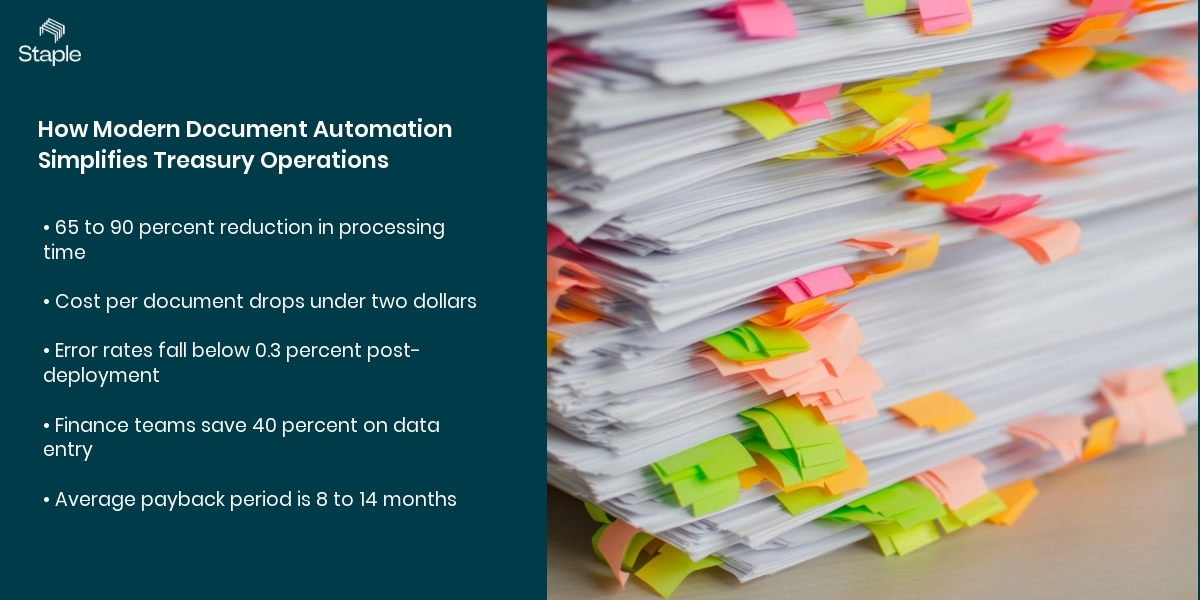
Embracing AI-integrated systems brings transformative change to treasury functions. Automated documentation processes reduce manual intervention, creating a streamlined financial control environment. By utilizing AI document processing as the missing link in treasury operations, businesses achieve real savings in time and costs.
Staple AI provides comprehensive solutions, targeting inefficiencies and delivering significant advances in accuracy and speed. Implementing robust features like intelligent tables and master data mapping helps consolidate multi-sourced data into a cohesive format. This enhancement empowers finance leaders by granting control over treasury strategies. With Accounts Payable automation services from Staple AI, the entire document lifecycle can be refined, bringing accuracy and efficiency to FX reconciliation.
Integrating such systems becomes seamless when enterprises facilitate gradual adoption. Training teams and investing in change management practices ensure smooth transitions. Once integrated, feedback from finance teams often reflects increased confidence in executing strategic decisions backed by real-time insights.
Treasury Automation ROI: What Industry Experts Highlight
A report from McKinsey highlights that organizations embracing treasury automation can achieve up to 40% faster processing times. Increased process efficiency translates to quicker strategic decision-making, proving critical in volatile markets.
According to Gartner research, improving document processing for FX reconciliation is a priority for a growing number of CFOs. Their reports point to tangible improvements in decision-making speed and accuracy, further corroborated by financial gains.
Research consistently shows that enterprises utilizing AI-powered FX reconciliation tools report significantly higher accuracy in forecasting. Predictive analysis using AI has cut down the margin of error typically seen in manual processes.
Ardent Partners data reveals that the average invoice exception rate stands at 22.5%, compared to just 9% for best-in-class organisations , a difference that directly translates to processing speed and supplier relationship quality.
Frequently Asked Questions
How does AI improve FX reconciliation?
AI improves FX reconciliation by automating document processing, enabling faster data extraction and analysis. This automation ensures real-time updates on currency movements, reducing the risk of manual errors and enhancing accuracy in financial reporting. Such precision is crucial for making well-informed, timely strategic decisions.
What are the benefits of incorporating AI in treasury management?
AI in treasury management increases efficiencies by automating routine tasks, thereby freeing up human resources for more strategic initiatives. Treasury strategy using AI document extraction allows for better data accuracy, faster reconciliation processes, and improved decision-making flexibility.
Can AI help in reducing operational costs in finance departments?
Absolutely. AI-powered FX reconciliation tools streamline documentation processes, eliminating time-intensive manual efforts. This efficiency results in lower operational costs, fewer errors, and more targeted use of financial expertise, contributing to substantial cost savings over time.
Are there any security risks with AI document processing?
While concerns exist, AI systems are designed with robust security measures to protect sensitive data. Encryptions, access controls, and monitoring ensure data remains confidential. Ongoing advancements in cybersecurity continuously address potential threats, keeping systems secure.
How quickly can businesses see ROI from AI treasury automation?
The ROI from AI-powered solutions can be seen in a relatively short time, often within a year. Businesses typically notice improvements in process efficiency and accuracy quickly. The exact timeline depends on the scale of implementation and the existing infrastructure.
How Staple AI Can Help
Staple AI offers powerful solutions designed to transform documentation processes in treasury. With features like Intelligent Tables and automated reconciliation, it ensures data accuracy and streamlines workflows. The platform's ability to adapt and integrate with existing treasury systems means a smoother transition and less business disruption.
The implementation of Staple AI's solutions is straightforward. Initial assessments define the integration approach, ensuring that each step aligns with an organization's treasury strategy. This thoughtful deployment reduces risks and accelerates the benefits of document processing for FX reconciliation in the early phases of adoption.
Thinking about revolutionizing your treasury operations with AI-backed tools? Check out Staple AI's comprehensive offerings for tooling your treasury strategy using AI document extraction. Let’s redefine your reconciliation process together, visit our Banking and Financial Services sector page to learn more.

.png)