
The Anatomy of a Trust-First AI Platform: Inside Staple’s Stack

Quick answer
Staple AI's trust-first AI platform leverages a unique three-layer architecture encompassing document, data, and trust layers to ensure secure document processing and compliance. With unmatched accuracy and audit-readiness, it transforms chaotic data into structured, reliable insights for enterprises.
The Anatomy of a Trust-First AI Platform: Inside Staple’s Stack
We've all been there, the sting of a missed deadline because the right data wasn’t accessible at the right time. Imagine the frustration of an enterprise finance director who realizes that a critical audit trail has gaps, with bottlenecks in the document processing system. This scenario is all too common in enterprises lacking a trust-first AI platform. In my experience, teams spend countless hours reconciling mismatched data, a problem that Staple AI set out to solve with its comprehensive and secure AI architecture.
At Staple AI, we focus on building a trust-first framework that ensures data is both accessible and reliable. Our Enterprise AI platform is designed to cater to the specific needs of multinational enterprises handling millions of documents across complex regulatory landscapes. How do we achieve this? By implementing secure AI architecture that transcends basic extraction to deliver a full audit-first AI design. This is what sets us apart from average document AI tools.
Understanding Staple AI's Trust-First Platform
Staple AI's trust-first AI platform is fundamentally grounded in its three-layer architecture, designed to interrogate documents at every level of the process. First, there's the Document Layer, which focuses on verifying the authenticity of documents. This layer uses pixel-level forensics and metadata analysis to classify documents as genuine, fraudulent, or suspicious. Its inclusion ensures that tampered documents do not slip through unnoticed.
Second, the Data Layer takes over with context-based extraction and AI contextual verification. It’s not about simply pulling data from forms; it’s about accurate extraction, verification, and contextual understanding. This layer also includes a comprehensive reconciliation system that manages cross-document type reconciliation, enabling error rates to drop significantly below industry norms.
Finally, we have the Trust Layer, ensuring every processed document is tamper-evident and audit-ready. The trust-first design embeds provenance at the field level, offering an immutable chain of custody for all document-related actions. This capability addresses regulatory audits with confidence, providing a full history of every action, reviewer, and decision made.
Importance of Secure AI Architecture in Enterprise Operations
Research consistently shows that enterprises without a secure AI architecture face increased risks in data breaches and inaccuracies. According to the ACFE 2024 Report, organizations lose an estimated 5% of their annual revenues to occupational fraud, often exacerbated by inadequately protected document processing systems. With a trust-first AI platform, these vulnerabilities are minimized. A comprehensive Enterprise AI platform like Staple AI's enhances security while maintaining high operational efficiency.
• Secure architectures mitigate data breaches.
• A trust-first foundation supports regulatory compliance.
• Enhanced data accuracy reduces operational disruptions.
• Fraud detection mechanisms save costs and protect revenue streams.
• Robust reconciliation systems minimize processing errors.
• Streamlined document workflows increase efficiency.
• Audit-first designs provide transparency and credibility.
Benchmark: How Top Performers Compare
According to Gartner, organizations that employ an enterprise AI platform with a secure AI architecture experience far fewer security incidents. The top quartile of enterprises employing such systems experience significantly fewer data breaches compared to the bottom quartile. This significant gap indicates the strategic upper hand gained by those who invest in trustworthy AI systems. Organizations in the top quartile demonstrate markedly faster problem resolution rates, showing how a trust-first AI platform reduces downtime and ensures business continuity.
Moreover, top performers demonstrate substantially greater accuracy in data reconciliation, leading directly to more precise financial reporting. Enterprises with audit-first AI designs gain improved decision-making capabilities due to enhanced data reliability.
Real Data Insights: Beyond Just Compliance
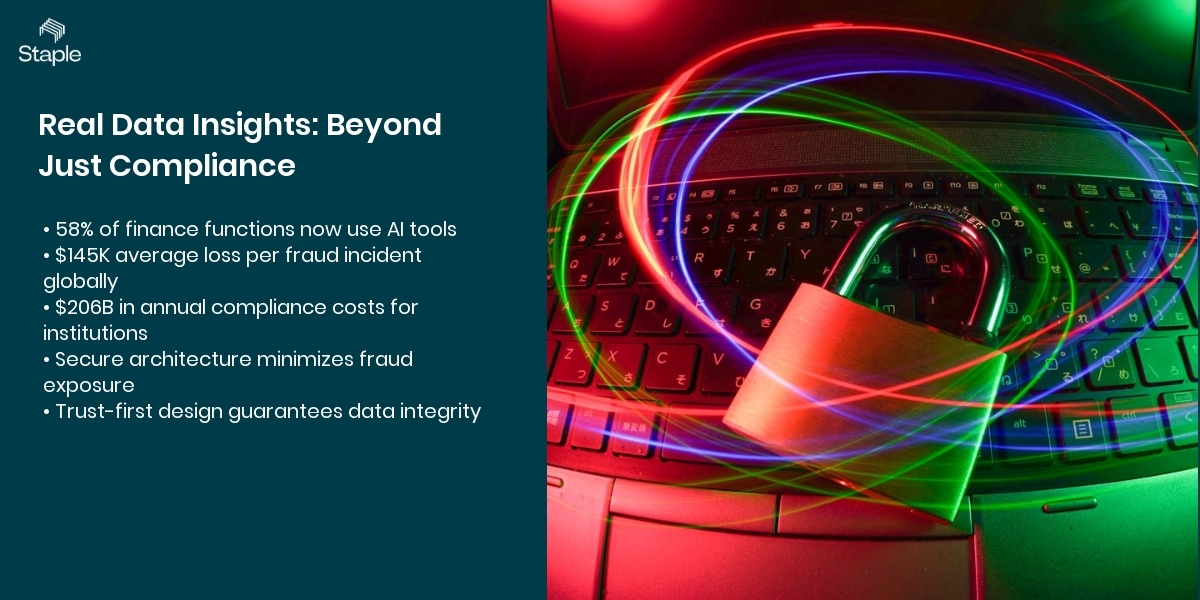
The magnitude of implementing a trust-first AI platform is underscored by numerical data. First, consider that 58% of finance functions are now utilizing AI technologies like Staple AI's, as reported by Gartner. Second, a report by ACFE reveals that the average financial loss per fraud incident is approximately $145,000. Lastly, LexisNexis highlights the exorbitant costs of financial crime compliance for institutions, tallying over $206 billion annually. These figures demonstrate the crucial importance of a secure, trustworthy AI system.
Enterprises implementing a secure AI architecture not only protect themselves against fraud but also streamline their operations, significantly reducing process errors. Strategically, they position themselves as industry leaders through innovation and secure, efficient processes. Enhanced customer and client trust arises from ensuring data integrity and compliance.
Operational Mechanics: Secure AI Architecture at Staple
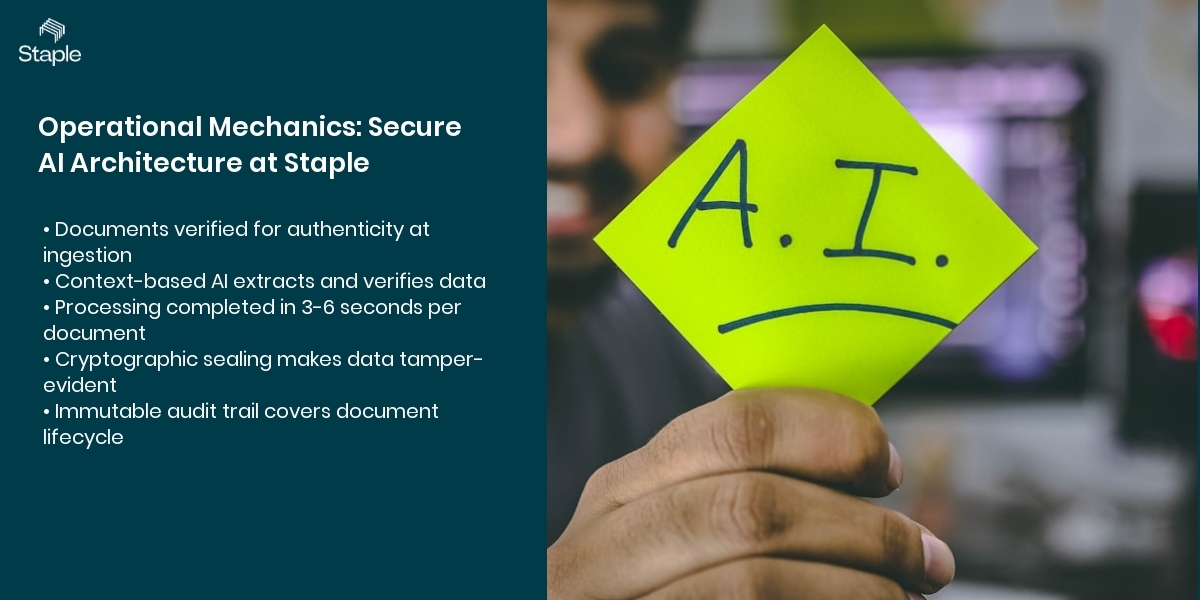
In the Staple AI stack, secure AI architecture functions through layered security protocols and a trust-first design that ensures data integrity at every step. Starting with document ingestion, our AI scrutinizes documents for any evidence of tampering. This immediate classification is essential in preventing fraudulent activity.
The process then extends to data extraction and analysis, wherein context-based AI identifies and verifies data with astounding accuracy. This approach not only improves data integrity but also ensures rapid processing, with average times ranging from 3 to 6 seconds per document.
Finally, the architecture secures the data in a tamper-evident format. By using cryptography, every piece of extracted data can be traced back through an immutable audit trail, providing comprehensive transparency and accountability throughout the document's lifecycle.
The Challenges in Developing Trust-First AI Systems
Developing trustworthy AI systems is no small feat. The first challenge often lies in achieving perfect integration within existing enterprise systems. Many AI platforms fail due to compatibility issues or insufficient customization options, both hurdles that Staple AI's trust-first AI platform overcomes with its adaptable architecture.
Another significant challenge is ensuring the AI system's security and compliance with ever-evolving regulatory standards. Without an audit-first design, organizations risk substantial fines and reputational damage. Moreover, maintaining data integrity and accuracy is a persistent struggle, often exacerbated by the reliance on legacy systems that lack the full capabilities of a dedicated Enterprise AI platform.
• Integration with existing systems is complex.
• Ongoing regulatory compliance is demanding.
• Data integrity is constantly challenged.
• Legacy systems may not support modern AI capabilities.
• Scalability of AI systems can be limited.
• Trust-first designs mandate ongoing investments.
• Technological adoption poses training challenges.
Specific Solutions Through Modern Document Automation
Modern document automation, particularly through a platform like Staple AI, addresses these challenges head-on by integrating trust-first architecture and comprehensive AI frameworks. By processing documents with unparalleled speed and accuracy, Staple AI eliminates bottlenecks typical of traditional methods. The platform's adaptability allows integration with existing enterprise systems, offering a flexible solution that is scalable and easy to deploy.
Staple AI also anticipates future compliance needs through its audit-first design, meaning enterprises can confidently adapt to changing regulations without reconstructing their entire system. Furthermore, the use of cryptographic sealing and tamper-evident measures ensures data integrity from start to finish, a standard not commonly maintained by other providers.
ROI and Analyst Insights on AI Platforms
In analyzing the ROI of trustworthy AI systems, the numbers tell a compelling story. Enterprises deploying trust-first AI platforms consistently report significant productivity gains alongside industry-leading data accuracy rates, translating directly into cost savings and enhanced operational performance.
Further, According to McKinsey, AI delivers between 2.8% and 4.7% productivity improvement annually in financial services, gains that compound when applied to document-intensive workflows. With these figures in mind, it's clear that implementing a trust-first AI platform like Staple's not only bolsters an organization’s bottom line but establishes it as a leader in compliance and innovation.
How Staple AI Can Help
Staple AI's trust-first AI platform brings numerous capabilities to the table that position enterprises for both near-term gains and future readiness. Featuring a no-code interface, it allows for the integration of new document types without extensive development resources, ensuring your platform grows alongside your business needs. This flexibility is an integral component of our secure AI architecture.
Moreover, with extensive coverage of up to 300 languages and rapid document processing times, Staple AI supports multinational enterprises effectively. The platform's auto-classification, reconciliation, and AI-powered verification provides businesses with a comprehensive solution, helping them cut through inefficiencies and embrace a new era of accuracy and compliance.
Experience what a trust-first design can do for your enterprise's document processing. Visit our accounts payable automation or Intelligent Tables pages for more information. Join us in transforming your document workflows into a secure and streamlined process.
Legacy Document Processing vs. Trust-First AI Architecture
Legacy Document Processing: Manual, Error-Prone, and Audit-Vulnerable
• Manual document handling introduces human error at every stage of the process.
• Legacy systems lack real-time verification, allowing fraudulent documents to pass undetected.
• Compliance gaps are discovered reactively, after breaches or audits have already occurred.
• Data extraction from unstructured documents requires costly human review cycles.
• Audit trails are incomplete, making regulatory reporting time-consuming and unreliable.
• Siloed systems mean reconciliation across document types demands heavy manual effort.
• Scaling manual document workflows requires proportional increases in headcount and cost.
Trust-First AI Architecture: Automated, Accurate, and Audit-Ready
• Pixel-level forensics verify document authenticity before any data is extracted.
• Context-based AI extraction captures the right data regardless of document format or template.
• Compliance adherence is proactive, with tamper-evident records created at every step.
• Cross-document reconciliation is automated, eliminating manual matching across data sources.
• Immutable audit trails provide regulators with a complete, unalterable chain of custody.
• Cryptographic sealing ensures data integrity from ingestion to final report.
• Processing scales to millions of documents annually without adding operational overhead.
FAQ: Answering Key Questions About Trust-First AI Platforms
What makes Staple AI's platform "trust-first"?
The trust-first AI platform by Staple AI differentiates itself through a comprehensive architecture focusing on document authenticity, secure data handling, and audit-readiness. Our unique Document, Data, and Trust Layers collaborate to ensure every document processed is genuine, every extracted data piece is secure, and every action taken is fully traceable. This integrated approach guarantees adherence to compliance standards and fosters a trustworthy relationship between enterprises and their data.
How does secure AI architecture improve enterprise operations?
Secure AI architecture fundamentally boosts enterprise operations by ensuring the integrity and accuracy of data across the organization. It minimizes instances of fraud and inaccuracies, providing a stable foundation for decision-making. Additionally, it accelerates processing times and reduces error rates, enabling teams to focus on strategic initiatives rather than manual reconciliations. As a result, enterprises experience improved efficiency and reduced compliance risks.
What challenges do enterprises face without a trust-first AI platform?
Enterprises without a trust-first AI platform often struggle with inefficiencies and heightened compliance risks. They are vulnerable to data tampering and fraud due to inadequate document verification systems. Such platforms lead to unreliable data, resulting in costly errors and potential legal issues. Moreover, without audit-ready capabilities, enterprises face significant hurdles in maintaining compliance and customer trust.
What are some features of Staple AI that support its secure architecture?
Staple AI's secure AI architecture boasts several key features, including its three-layer architecture for document, data, and trust management. It offers pixel-level document forensics, AI-based data verification, and cross-document reconciliation utilizing advanced analytics. Cryptographic sealing ensures data integrity, while metastructured data provides an unfaltering audit trail. This multifaceted security and integrity approach defines Staple’s comprehensive enterprise AI platform.
How do you measure success? What KPIs should we track?
Success with a trust-first AI platform like Staple AI can be measured through several KPIs. Key metrics to track include data processing speed (targeting 3-6 seconds per document), data accuracy rate (aiming for 95% or higher), productivity improvement (significant gains as demonstrated by enterprise deployments), document processing volume (millions annually), and compliance achievement rate, targeting near-complete adherence to relevant regulatory requirements.
By benchmarking these KPIs, enterprises can not only gauge their current performance but pinpoint areas for future improvement in their pursuit of operational excellence and compliance.
Achieving a comprehensive and secure AI architecture may sound complex, but the steps toward a compliant, efficient, and trust-first design are clear with Staple AI. Make the transition today and secure your enterprise's data and operations for tomorrow.

.png)