
Banks and lenders
Trusted first-mile data processing for banking
Intelligent document processing for banks and lenders. Verify POI, POA, SOF, SOW, company records across 300+ languages and step in only to handle exceptions. Start with a use case and automate data processing function in your entire organisation.
Documents you don’t control make compliance harder
Every loan application, customer due diligence and anti-money laundering (AML) review runs on documents received from outside your organisation: your customers.
At times, bank statements run to hundreds of pages, making them time-consuming for reviewers. AI can pitch in and help, but can it provide accountability for its decisions?

Document
It’s not that hard to edit a bank statement
Documents like bank statements, payslips, ID proofs and balance sheets can be edited or even generated using AI.

Data
Mismatches can easily slip through
Say, for a loan application, the salary in the payslip should match the bank statement, offer letter and application. Now imagine doing the same for a business loan, where there are far more documents, figures, and details verify.

Trust
Policy isn’t proof
Policies serve as guardrail over what is approved.
However, when an auditor asks why it was approved, rebuilding that record is time-consuming. For an AI decision, it may not be possible to reconstruct at all.
Document
Check the trustworthiness of a document
Fraud detection in banking starts before extraction: identify tampered and AI-generated KYC and KYB documents, bank statements, payslips and financial statements.
Focus only on handling exceptions
Say Josh’s bank statement is tampered with: inspect only that document and proceed with the others.
Data
Shorten processing time and inspect issues alone
Auto-classify documents and flag name, address, ownership and income mismatches across supporting documents.
Make better-informed approvals
Cross-check extracted data with trusted external parties such as credit bureaus and registries.
Trust
Record who did what and why
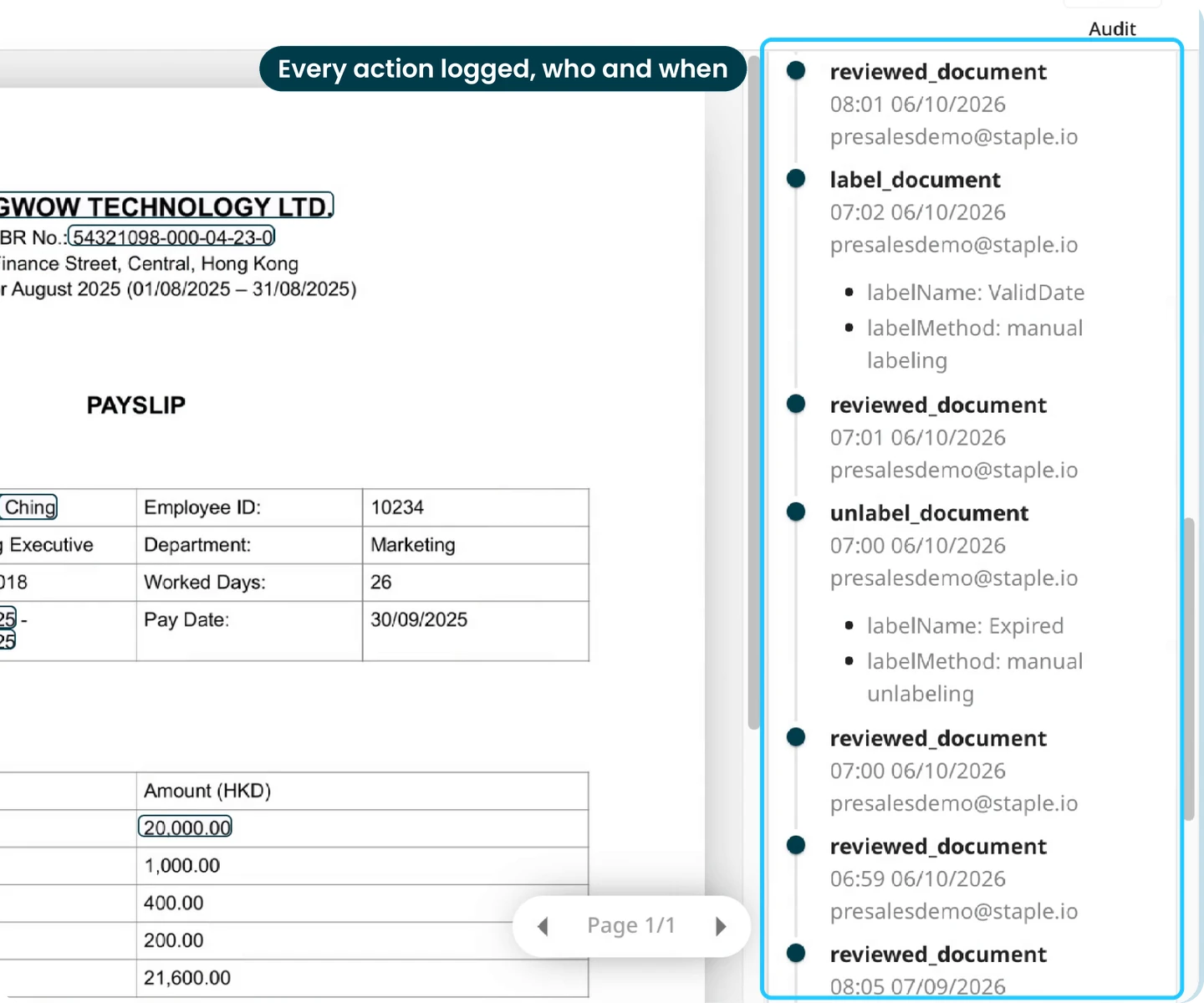
Track every action taken by the AI and the reviewer during data extraction and reconciliation.
Answer audit questions faster
Seal the evidence so that any change can be tracked, and meet data residency rules by keeping data in your region.
How Staple automates document processing for banking
Process banking documents you can trust
Staple’s document fraud detection reviews IDs, bank statements, payslips and all kinds of financial documents for tampering and AI-generated content.
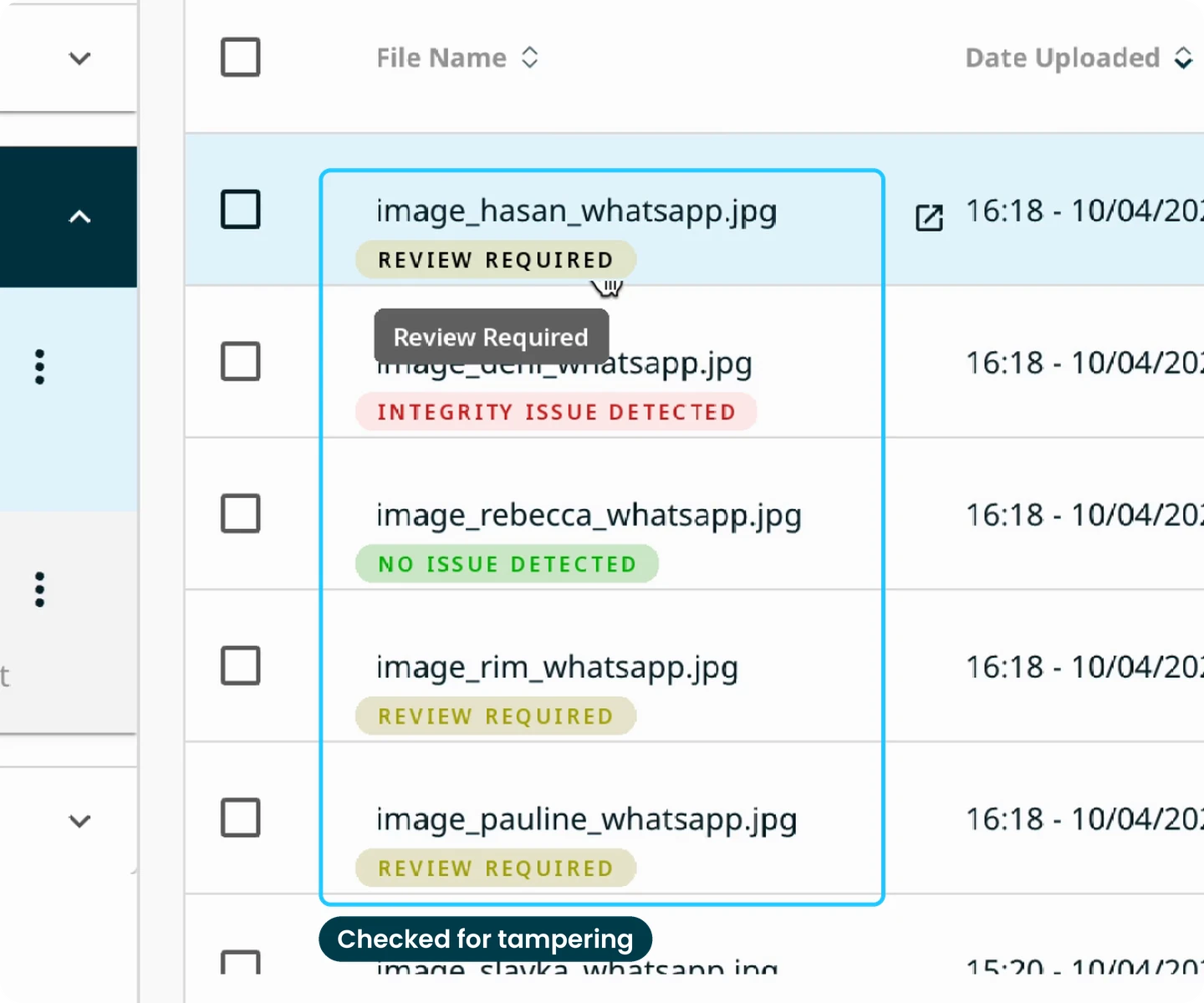
Staple marks each file with one of the five labels, making it easier for the reviewer to inspect only the problematic ones: Provenance verified, Review required, No issue detected, Integrity issue detected and Unable to assess.
It inspects file metadata like creation date, modification history and software origin, and runs pixel-level checks to identify suspicious activities that a reviewer’s eye can miss.
Collect, split and extract
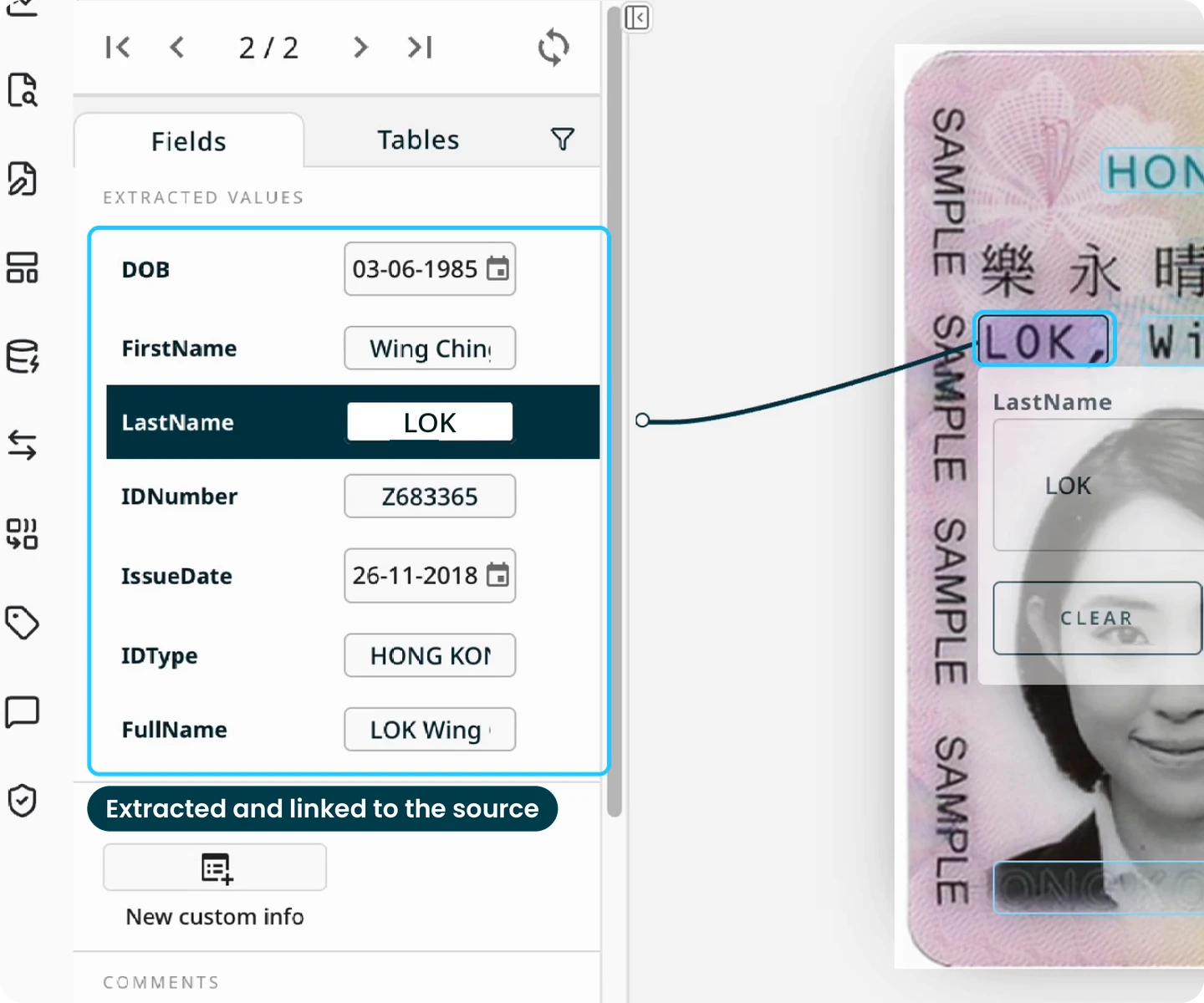
Staple can receive documents from customers which arrive from any source, such as email, or even internal ones from SFTP or API. It splits documents, say when an applicant sends the POI and POA in one PDF, and auto-classifies them.
Once the documents are in, it extracts header fields and line items from complex tables, across 300+ languages, including handwriting and stamps.
Verify data using AI and with trusted external sources
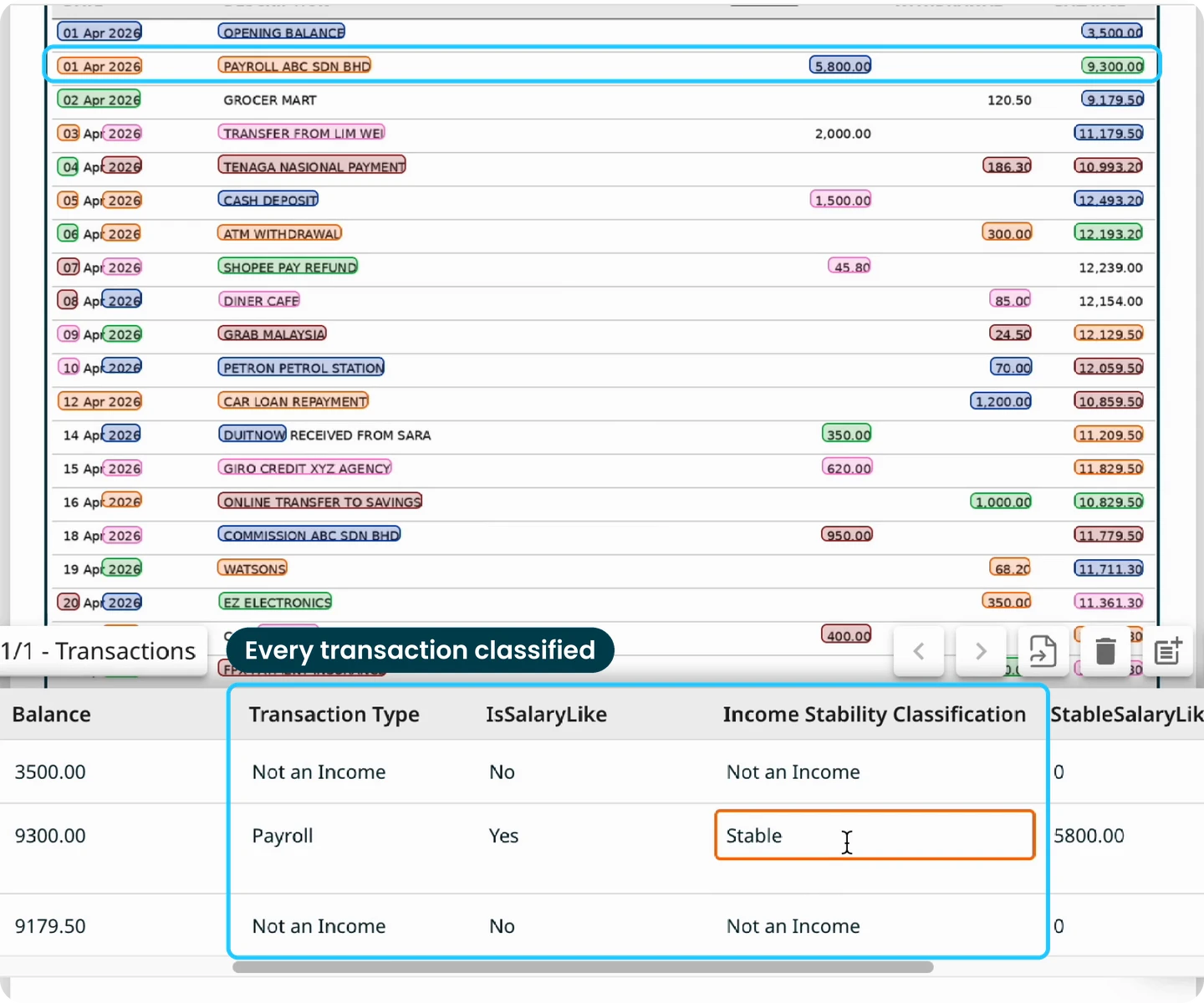
Staple can do data verifications in four ways depending on your banking process
- Cross check the extracted data with external trusted parties like credit bureaus and registries.
- Verify data contextually using AI. Like shown in the image on the right, categorise transaction type in bank statements and go one step further to analyse whether the income is stable or not.
- Identify anomalies like statement totals that don’t match the credit and debit transactions.
- The most important one, cross document reconciliaition to identify exceptions, check the next section
Link, compare and identify exceptions while you sleep
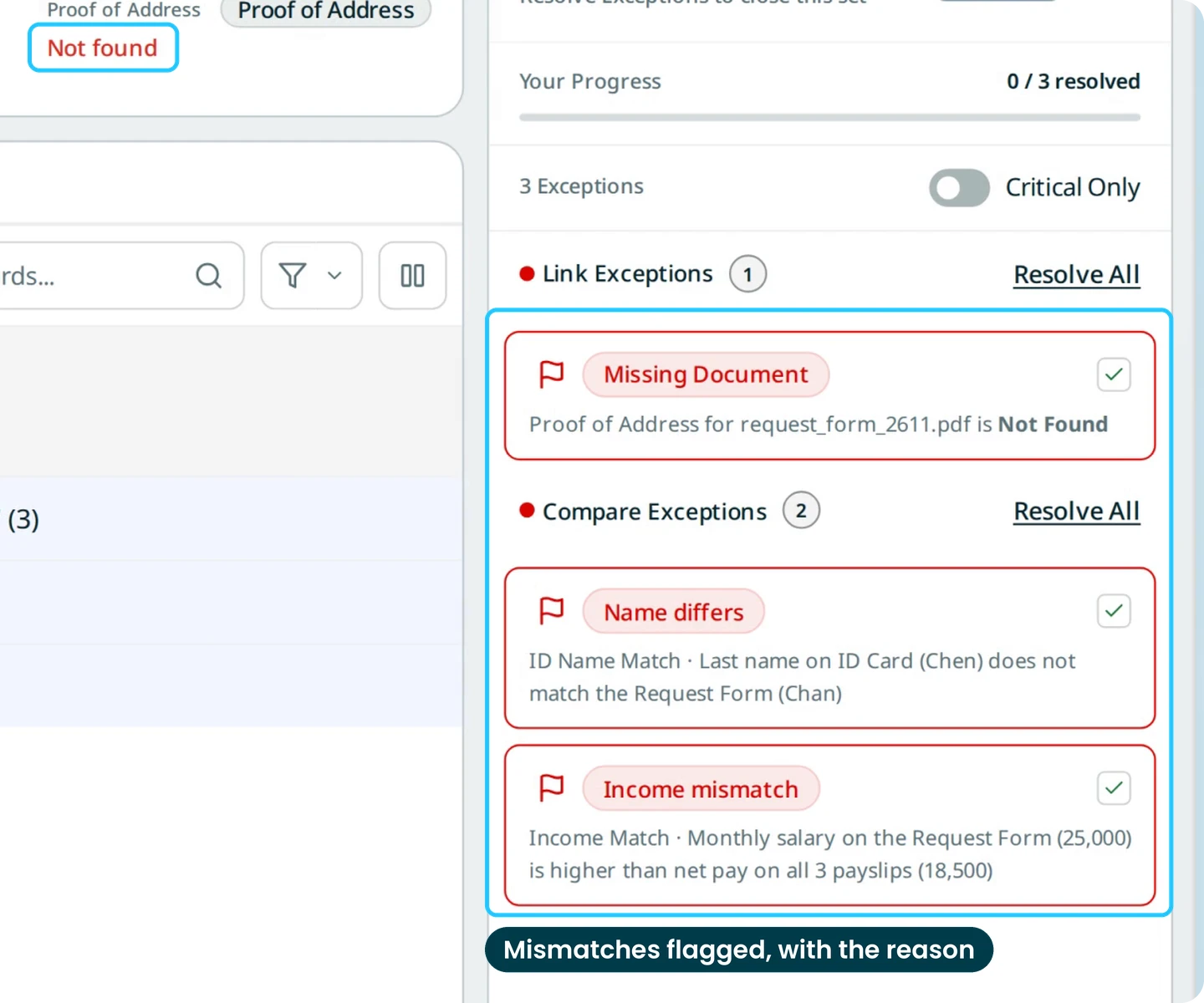
Staple links all the documents submitted and compares the data extracted across them, such as applicant name, date of birth, ID number, address, salary, tax ID and bank balance, across proof of identity (POI), proof of address (POA), source of funds (SOF), source of wealth (SOW), company records and balance sheets.
All of this happens automatically, and the reviewer has to step in only when there are exceptions.
Push trusted data into your business systems and stay audit-ready
Staple records how every decision was made by the AI and the reviewer, with changes and timestamps, and seals the evidence so any later change can be detected.
Verified data goes into your onboarding, credit and AML compliance systems through APIs, where sensitive data can be redacted before a document is shared.
When an auditor asks, you show who did what, when and why, without rebuilding the trail.


KYC and KYB document verification
Verify identity, address, source of wealth and company documents before data enters your onboarding and AML systems.

Bank statement analysis and verification
Verify bank statements, income documents and financial statements before they reach credit decisions, including income verification and financial statement spreading.

Document tampering and AI-generation checks
Catch edited documents on arrival, verify transactions in context and reconcile funds across statements and records.
Insurance documents from intake to settlement
Insurers face the same compliance and multilingual challenges as banks, with an added layer: complexity across document types.
Staple processes claims and policy documents, accident and medical reports, KYC onboarding files, and personal income verification.
The claims file, medical report, policy document, and supporting evidence are matched on one screen, with automatic detection of duplicate claims or billing code mismatches.
“We can find extraction tools from a number of vendors today, but what Staple provides is so much more. You have explainability, audit trails, and liability protection from regulators, to whom we need to demonstrate ongoing compliance year in and year out. This is the elevated protection that Staple provides.”
Head of Compliance
Major Insurer

See how financial institutions use Staple
Bring your bank statements, KYC files or claims documents. We’ll extract from your actual files so you can benchmark accuracy.
Document processing for banks: FAQs
What is intelligent document processing in banking?
Intelligent document processing in banking classifies documents, extracts the data and verifies it against the organisation’s business rules, and newer platforms also check documents for tampering or AI-generated content first.
Staple checks every document for tampering and AI-generated content before extraction, extracts the data in 300+ languages, cross-checks it across documents and trusted external sources and records every action, so reviewers only handle the exceptions.
How do banks detect a fake or edited bank statement or payslip?
Banks detect a fake or edited bank statement or payslip by checking the file for signs of editing in its metadata, fonts and pixels, and by checking whether the figures inside it add up, like a running balance that matches the transactions.
Staple’s document verification software checks every bank statement and payslip, marks it Provenance verified, No issue detected, Review required, Integrity issue detected or Unable to assess, and flags totals that don’t match. This way, the reviewer only focuses on inspecting the documents that are suspicious.
How can a bank show an auditor how a document-based decision was made?
A bank can show an auditor how a specific document-based decision was made by keeping a record of what was received from the customer, what was checked, who reviewed it and when, and why the reviewer approved or rejected the application. That record, in any case, should not be quietly changed later.
Staple records every action taken by the AI and the reviewer and seals the evidence, so any later change can be detected and your team retrieves the record instead of rebuilding it.
Does Staple replace our AML compliance software or loan origination system?
No. Banks usually run separate systems for anti-money laundering (AML) screening, case management, credit scoring and loan origination, and each depends on the documents and data fed into it.
Staple works alongside your AML compliance software and loan origination system: it checks the documents, verifies the data and pushes verified records into them through APIs, so it adds to the software you already run instead of replacing it.
How does Staple support income verification and financial statement spreading?
Income verification checks whether the loan applicant’s declared income is true, as mentioned in the loan application, and whether it is stable. Financial statement spreading, meaning manually copying figures from a borrower’s financial statements into the bank’s credit template, takes hours to process.
Staple categorises every credit and debit transaction as income or not and analyses whether the income is stable. It flags applicants whose income is below your minimum threshold. For businesses, it also cross-checks financial statements such as balance sheets against their bank statements.
Can Staple process bank documents in Chinese, Thai, Bahasa and handwriting?
Staple processes all banking and financial documents in 300+ languages, including Chinese, Thai and Bahasa, handwriting, rubber stamps and mixed-language fields. It can also send low-confidence fields to a reviewer to check and approve.
Can bank data stay in-country?
Of course, yes. Many banks keep customer data in-country under data protection rules like PDPA, PIPL and GDPR, so where a vendor processes and stores data matters.
Today, Staple keeps bank data in one of four data centres, in Singapore, Germany, the USA and China, and encrypts it at rest and in transit. Staple can also store data in a specific country as per the customer’s wish and organisational requirements.
Who makes the final credit or onboarding decision when AI is used?
Of course, the final decision is made by the bank or the financial institution only. Banks stay accountable for every credit and onboarding decision, so regulators expect human oversight of AI and a record of how each decision was reached.
Staple verifies, cross-checks and flags anomalies and anything outside your business rules. However, it is your reviewers who make the final credit or onboarding decision. During and after the decision, Staple stays with you through the process, where every action by the reviewer and the AI is recorded and sealed for future audit purposes.