
AI Contextual Verification
Understand what the data means before anyone acts on it.
Reading a field correctly isn't the same as understanding it. Staple reasons over a document's content in context, distinguishes what it inferred from what the document actually said, and exposes the evidence behind every judgment, so a person can check the reasoning instead of trusting a black box.
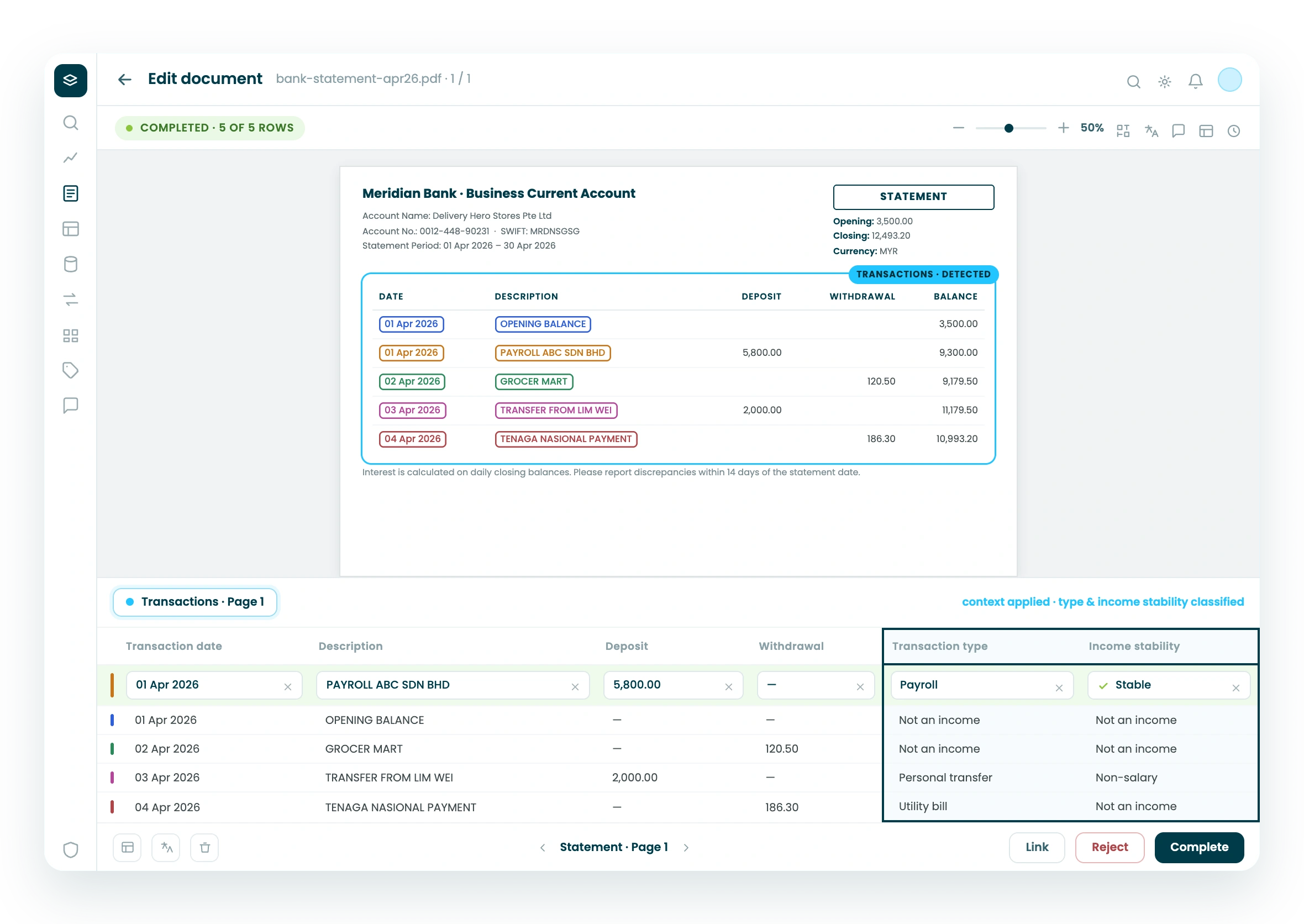
A correctly read number can still be the wrong number.
Literal extraction captures what's on the page.
It can't tell you that a transaction labelled "TT-SAL" is a salary payment, that a total belongs to a different section, or that a value is plausible for this vendor but not that one.
Meaning lives in context, and without it, clean extraction still hands your systems data that's technically accurate and operationally wrong.


Business Rules & Anomaly Detection
Apply your own rules to headers and line items, and flag exceptions automatically.

Data Extraction & Enrichment
Convert complex documents into structured, normalized, enriched data.

Cross-Source Reconciliation
Reconcile values and line items across related documents automatically.
See contextual verification on your own documents.
Book a 30-minute demo. Bring documents where meaning matters, bank statements, mixed charges, ambiguous line items, and we'll show the reasoning live.
FAQ
What is AI contextual verification?
It is Staple's ability to understand what extracted data means in context, not just read it literally. Staple reasons over headers and line items, infers meaning such as recognizing a salary transaction, separates inferred data from source data, and exposes its rationale so the judgment can be reviewed rather than blindly trusted.
How is this different from normal data extraction?
Extraction captures the characters in a field. Contextual verification interprets them: what a value means, which category it belongs to, whether it makes sense in context. A value can be extracted perfectly and still be operationally wrong, and this is the layer that catches that.
Does Staple distinguish between what it read and what it inferred?
Yes. Staple keeps extracted data, inferred data, and externally verified data separate. Inferred values are clearly labelled as inferred rather than presented as facts read directly from the document, so a reviewer always knows the basis for each value.
Can I see why Staple reached a particular conclusion?
Yes. Every contextual judgment comes with its rationale and supporting evidence. AI output is shown as reviewable, with reasoning visible, so a person can confirm, correct, or escalate it. It is never presented as an unquestionable result.
What happens with uncertain or high-impact data?
Values below the configurable confidence threshold, and outcomes flagged as high-impact, are escalated for human review instead of flowing through automatically. High-confidence routine data passes without friction, so review effort is focused where it genuinely matters.