
AI Powered Regulatory Reporting Reconciliation as the Foundation of Market Credibility

Quick answer
AI-powered regulatory reporting reconciliation provides unparalleled accuracy and efficiency, primarily through automation and AI algorithms, significantly reducing human error in financial reports. It streamlines data processing, ensures compliance, and ultimately enhances market credibility by providing consistent and reliable financial information.
AI Powered Regulatory Reporting Reconciliation as the Foundation of Market Credibility
Imagine a finance office buzzing with chatter as deadlines approach. It's the end of the month, and every desk is crowded with piles of reports, spreadsheets, and sticky notes. Susan, the finance director, is drowning in regulatory documents that need reconciling.
She's feeling overwhelmed, frustrated with how time-consuming and manual the entire process is. As she looks around, she realizes everyone in her team is under the same pressure. Accuracy is paramount, and one misstep could lead to dire consequences for the company's market credibility.
She's stressed, and her team is exhausted, knowing that even a tiny reconciliation error could have massive repercussions. This isn't just Susan's story; it's a reality for countless finance teams across the globe.
This chaotic scene, often filled with human errors and time lost to menial tasks, was once unavoidable. But with the emergence of AI-powered technologies, the game has changed. No longer do companies have to fumble through manual processes. Instead, they can leverage cutting-edge solutions like AI regulatory reporting reconciliation. This approach cuts through the madness, offering precision, speed, and reliability that previous generations could only have dreamed of.
How AI Regulatory Reporting Reconciliation Works
In my experience, AI regulatory reporting reconciliation transforms the chaotic mess of traditional processes into a streamlined operation. But how exactly does it do this? Let's explore.
Manual Regulatory Reporting Reconciliation:
• It often involves time-consuming manual data entry, which is prone to human error.
• Finance teams spend countless hours preparing reports due to complex regulatory requirements.
• Errors can lead to regulatory penalties, damaging market credibility.
• The process lacks visibility and transparency, making audits challenging.
• It is costly and requires significant manpower and resources.
• Compliance is harder to guarantee with manual oversight alone.
• Scaling manual processes is difficult given their resource-intensive nature.
AI-Powered Regulatory Reporting Reconciliation:
• It automates repetitive tasks, drastically reducing manual input and associated errors.
• AI algorithms analyze data faster, increasing speed and accuracy of reporting.
• Regulatory compliance is enhanced through reliable data validation.
• It provides real-time insights and transparency, making audits more efficient.
• Costs are reduced due to automation, requiring less manpower.
• Consistency in reporting minimizes risk of penalties and supports market credibility.
• Scalability can be easily achieved thanks to flexible AI-driven systems.
The Real Cost of Inadequate Reporting
In today’s fast-paced financial world, inaccuracies in regulatory reporting can be devastating. It’s not just the potential fines, although those are significant, but the reputational damage that can come from even a single mistake. According to a recent AI innovation blog regulatory penalties can cost firms up to 1% of their average yearly revenue. For multinational enterprises, such figures translate into millions of dollars.
Furthermore, time spent on correcting errors instead of focus on strategic work represents a massive loss of opportunity. A Gartner survey of 183 CFOs and senior finance leaders found that 58% of finance functions are now using AI, with 37% specifically implementing it for accounts payable and document automation, according to Gartner research. The longer this persists, the greater the risk of losing market credibility.
Broken trust with regulators and stakeholders can take years to rebuild. It’s a costly mistake that no finance team wants to make, yet it's one that happens all too often without appropriate systems in place.
Therefore, investing in AI regulatory reporting reconciliation is not just a smart move, it's a necessary one for sustaining and enhancing market credibility. Without this cornerstone, enterprises risk falling short on compliance and operational efficiency, ultimately allowing competitors to leapfrog them with ease.
How AI-Powered Regulatory Reporting Works Step by Step

Step 1: Data Ingestion. AI systems first collect vast amounts of data from multiple sources, including documents, spreadsheets, and databases. This step is crucial for building an accurate dataset, which forms the foundation for analysis. The AI algorithms then organize this data into a standard format, ready for processing.
Step 2: Data Pre-Processing. The raw data is cleaned and pre-processed, a crucial step for eliminating discrepancies or inaccuracies. Often overlooked in manual systems, this cleaning process is managed by AI tools that identify outliers and rectify them. The result is a clean, reliable dataset.
Step 3: Data Analysis and Reconciliation. Then comes the analysis stage, where AI systems compare datasets against existing records and regulatory requirements. This is where financial reconciliation tools shine. The outcome is a reconciled dataset that matches regulatory criteria down to the last detail.
Step 4: Report Generation. Once the data is reconciled, the system generates compliant reports automatically. These reports are then checked against compliance checklists to ensure they meet every regulatory requirement. AI algorithms perform this cross-referencing, which adds another layer of validation.
Step 5: Submission and Monitoring. Finally, the reports are submitted to designated regulatory bodies. AI-driven systems continue to monitor the process, flagging any deviations or issues instantly. The outcome is a seamless submission process, complete with alerts on compliance status and deadlines.
Why Accurate Reconciliation Is Challenging
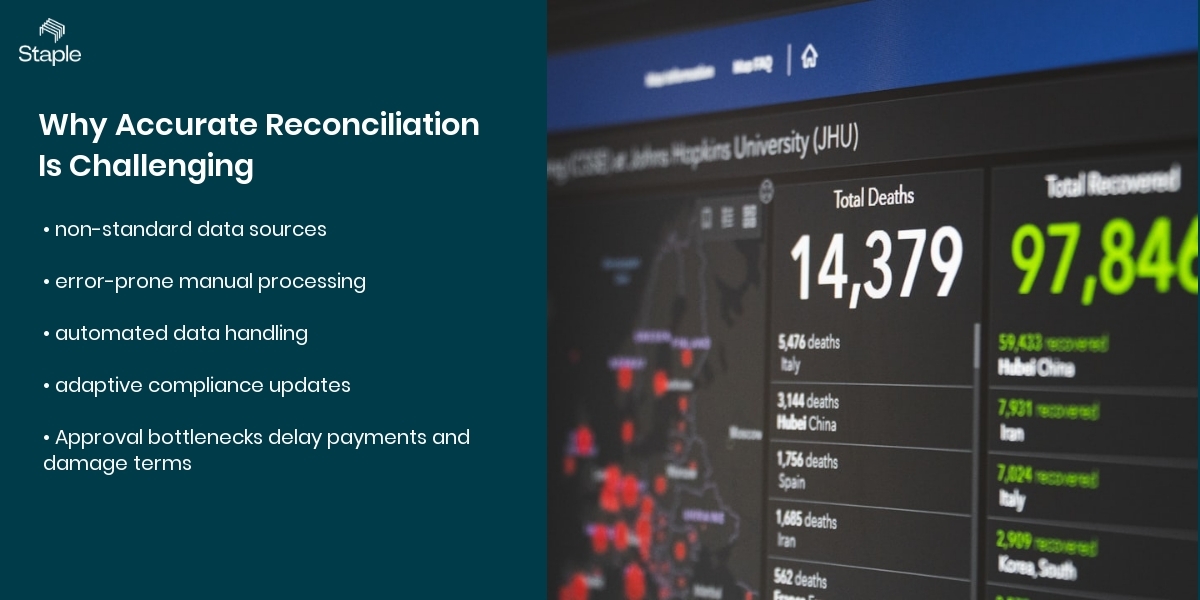
Complex Regulatory Requirements. Ever-changing regulatory landscapes make compliance a moving target for many firms. This evolution demands constant updates and understanding, which can overwhelm manual systems.
Lack of Data Standardization. Data typically comes from a myriad of unstandardized sources, posing issues for manual reconciliation. Without uniformity, records become harder to correlate, affecting accuracy.
High Risk of Human Error. Given the volume and complexity of financial data, human error is inevitable. Manual data handling exacerbates this exposure, leading to incorrect reports that jeopardize compliance and credibility.
How Modern Document Automation Solves These Challenges
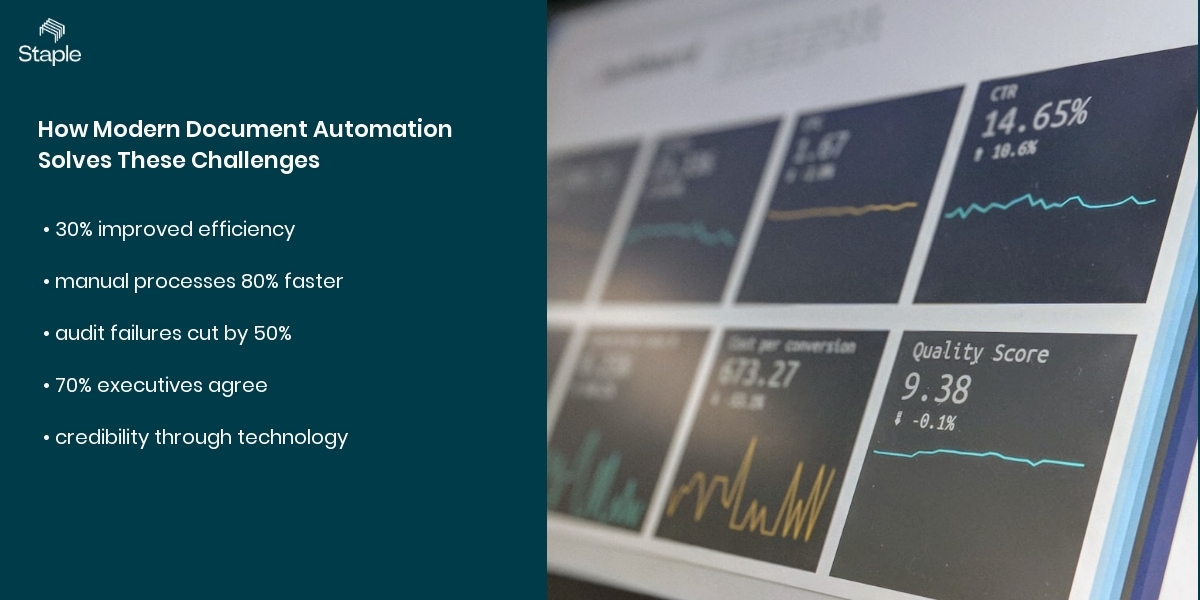
Modern document automation uses advanced AI to tackle complexities traditional methods cannot. It automates repetitive tasks, enabling companies to focus on compliance and strategic decision-making. AI regulatory reporting reconciliation tools reduce the burden on human resources by simplifying data processing and enhancing report accuracy.
By introducing features like continuous learning algorithms, these systems adapt to changing regulations faster than any human could. They’re always up to date, ensuring no compliance mandate is missed. A trusted partner like Staple AI, for instance, offers products that automate this entire lifecycle, from data ingestion to final reporting. Real-time analytics, compliance dashboards, and actionable insights become integrated into daily workflows.
The outcome? Companies not only avoid costly penalties but significantly boost their market credibility through accurate reporting. Process efficiency is improved, errors are minimized, and transparency is enhanced. With automation in place, reconciliation becomes a breeze rather than a burden, turning the focus back to strategic business growth.
Key Research and Data on AI Reporting
According to Gartner research, organisations that implement AI-powered reporting see significant improvements in compliance efficiency. This efficiency translates directly into cost savings and risk reduction, essential for maintaining market stability.
Research consistently shows that regulatory reporting automation software can dramatically reduce manual processing time. This level of efficiency reshapes what companies can expect from their finance teams, freeing up resources for strategic initiatives.
McKinsey research highlights that firms see significant reductions in audit failures when leveraging AI in regulatory processes. These improvements underscore the importance of integrating technology into financial reconciliation tools, reducing errors that impact credibility.
According to Deloitte research, a majority of executives believe that automation in regulatory reporting significantly increases market credibility. The link between technology and credibility is strong, offering firms a roadmap to sustain their competitive advantage.
Frequently Asked Questions
What is AI regulatory reporting reconciliation?
AI regulatory reporting reconciliation is a process where AI and machine learning technologies automate and enhance the accuracy and efficiency of compiling and verifying finance reports. These technologies streamline the reconciliation process by analyzing huge datasets with greater speed and precision than manual methods, ensuring that reports comply with increasingly complex regulatory requirements.
How does regulatory reporting automation software work?
Regulatory reporting automation software automates the repetitive aspects of data reporting, such as gathering and sorting data, conducting comparisons, and generating reports. By utilizing AI algorithms, these systems can quickly validate data according to regulatory standards, significantly reducing the chance of compliance errors while providing real-time analytics and insights.
Why is market credibility important in financial reporting?
Market credibility through accurate reporting is crucial as it fosters trust among stakeholders, investors, and regulatory bodies. Accurate financial reporting demonstrates a company’s transparency and reliability, essential for attracting and maintaining investor trust and avoiding financial penalties.
What are the challenges of manual financial reconciliation?
Manual financial reconciliation is often plagued by time constraints, human error, and inconsistency. These challenges can lead to significant compliance risks and financial discrepancies, damaging a company’s credibility. Bulk data from various sources further complicates the process, making error-free reconciliation nearly impossible without advanced tools.
How do financial regulatory reconciliation tools benefit enterprises?
Financial regulatory reconciliation tools automate data processing, reducing the time taken and minimizing errors. These tools boost efficiency, compliance, and market credibility by ensuring consistently accurate reporting. Ultimately, they empower firms to allocate more resources to strategic operational goals rather than focusing heavily on repetitive reporting duties.
How Staple AI Can Help
Staple AI offers cutting-edge solutions designed to optimize regulatory compliance automation in finance. With capabilities like custom model creation, intelligent tables and master data mapping, Staple AI can streamline your regulatory reporting process from start to finish. Our tools provide unparalleled accuracy and efficiency, reducing human intervention and allowing finance teams to focus more on strategic tasks that contribute directly to business growth.
The implementation process with Staple AI is straightforward. Our team assesses your current systems and identifies opportunities for integration, ensuring seamless data flow and reporting. The timeline for implementation can be customized to your specific needs, often taking only a few weeks to get fully operational with minimal disruption to your daily operations.
Ready to transform your financial reporting process? Discover how Staple AI’s innovative technology can enhance your market credibility through accurate reporting. Contact us today to learn more about our tailored solutions and start your journey towards operational excellence.

.png)