
Navigating the Intersection of AI and Financial Risk: A Proactive Approach

Quick answer
AI in financial risk management helps organizations anticipate and mitigate potential risks by analyzing vast amounts of data rapidly. This allows for proactive risk management strategies that can safeguard financial health, adapting to market changes more efficiently than traditional methods. AI-driven solutions transform reactive risk management into a strategic advantage.
Financial crime compliance costs now total $206 billion globally, and 98% of financial institutions report those costs are still rising, according to the LexisNexis True Cost of Financial Crime Report 2024. These figures unveil a persistent issue: reliance on outdated risk assessment tools that cannot keep pace with the rapid movements of the global financial environment. In this climate, overlooking the adoption of AI technologies becomes an expensive oversight.
The unsettling truth is that many enterprises continue to experience unexpected financial strain due to currency fluctuations or geopolitical developments, situations where traditional risk management frameworks fail to provide foresight. When the marketplace takes an unforeseen turn, delays in data processing can mean the difference between strategic agility and financial setback.
Here lies the urgency: integrating AI in financial risk management is no longer a futuristic vision but a necessity for survival. As these systems evolve, they promise not only unprecedented speed in data analysis but also precision in predicting and responding to potential risks, thus reshaping risk management into a proactive rather than reactive endeavor.
Understanding AI in Financial Risk Management
AI in financial risk management is fundamentally about utilizing advanced algorithms to predict, identify, and assess financial risks with unprecedented accuracy. The integration of AI into risk management processes allows organizations to rapidly process large datasets, identifying patterns and anomalies that would be impossible to detect manually. This enhanced capability transforms risk management from a primarily reactive to a proactive discipline, equipping firms with the insights required to make informed, strategic decisions well in advance of potential disruptions.
Traditional Risk Management Practices:
• Historically, financial risk management relied on manual risk assessment processes that required significant time and personnel effort.
• Reliance on static historical data often led to inaccurate predictions of future risks, due to the dynamic nature of financial markets.
• Analysts faced delays in response times as a result of manually aggregating and interpreting large, complex datasets.
• Traditional methods were heavily dependent on subjective judgment, increasing susceptibility to human biases and errors.
• The inability to process data in real-time often resulted in missed opportunities for timely risk mitigation strategies.
• Integration of various data sources was cumbersome, limiting a holistic view of enterprise risk exposures.
• Adapting to regulatory changes was slow, leading to potential compliance risks and added operational costs.
AI-Powered Financial Risk Solutions:
• AI-driven technologies utilize machine learning algorithms to analyze vast quantities of data quickly and efficiently, providing actionable insights.
• These systems are capable of recognizing intricate patterns across multiple data dimensions, which are often overlooked by human analysts.
• Continuous data monitoring by AI facilitates real-time risk assessment, allowing organizations to respond swiftly to emerging threats.
• By eliminating human biases, AI enhances the precision and objectivity of financial risk forecasts and strategies.
• AI solutions integrate with existing data platforms, offering a comprehensive and centralized risk overview.
• AI technologies can adapt to evolving regulatory requirements, ensuring consistent compliance and reducing legal liabilities.
• Efficient automation of routine analytical tasks through AI significantly boosts operational scalability and cost efficiency in risk management functions.
Data-Driven Insights: Validating AI in Financial Risk Management
According to the AFP 2025 Payments Fraud and Control Survey 79% of organizations faced payments fraud attempts in 2024. This glaring statistic highlights the critical need for specific financial risk AI solutions that can detect and mitigate such risks. Furthermore, Gartner's 2024 survey states that 58% of finance functions were using AI, marking a significant acceleration from previous years and emphasizing the growing reliance on AI for proactive risk management.
Additionally, McKinsey’s 2023 report on the economic potential of generative AI reveals that industries could automate up to 70% of work hours, hinting at the transformative impact of AI on operational environments, including financial risk management. Not adopting such technologies could mean missed opportunities for increasing organizational efficiency and protecting financial assets.
Proactive AI Risk Management: A Workflow Breakdown

Step 1: Data Collection and Integration. In this initial stage, a vast amount of financial data is collected from various sources, including market trends, transactional data, and regulatory changes. Advanced AI systems then integrate this data into a centralized repository for seamless analysis.
Step 2: Pattern Recognition. AI algorithms process the integrated data to identify patterns and trends that may indicate potential financial risks. This stage is critical for recognizing anomalies and forecasting future risks with accuracy.
Step 3: Risk Scoring and Assessment. AI systems assign a risk score to each identified potential risk, prioritizing them based on the level of threat they pose to the organization. This enables decision-makers to focus on the most critical risks.
Step 4: Predictive Modeling. Utilizing historical data and current market conditions, AI develops predictive models that forecast financial risks and their potential impacts. This step provides a proactive approach to risk planning and management.
Step 5: Mitigation Strategy Development. The AI-driven insights inform the development of strategic risk mitigation plans. Organizations can then implement these strategies promptly to safeguard their financial health against identified risks.
Challenges in Implementing AI for Financial Risk Assessment
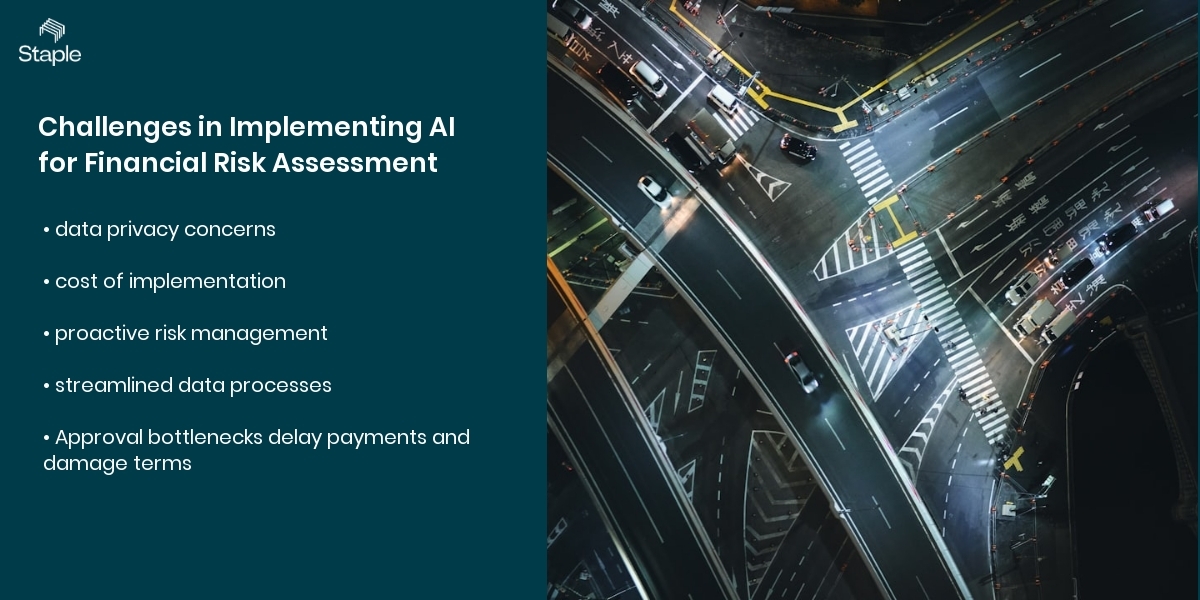
Data Privacy Concerns. The use of AI necessitates access to sensitive financial data, raising concerns over data privacy and protection, which can limit its deployment.
Integration Complexity. Integrating AI solutions with existing systems can pose significant technical challenges, requiring substantial IT resources and expertise.
Cost of Implementation. The initial investment in AI technologies can be prohibitive for some organizations, requiring careful cost-benefit analysis and budgeting.
How Document Automation Changes Financial Risk Management

Modern AI-driven document automation solutions transform how organizations handle the complexities of financial risk management. With solutions like Staple AI, companies can efficiently automate the data ingestion, processing, and analysis required for comprehensive AI financial risk assessment. By automating these processes, Staple AI ensures that data is processed continuously for real-time insights.
The application of AI in these solutions reduces reliance on manual, error-prone processes, enhancing the accuracy and reliability of risk assessments. Additionally, by integrating AI with existing financial systems, firms can achieve a holistic view of their risk landscape, allowing for more strategic proactive risk management. For instance, Staple AI's intelligent tables feature provides structured data outputs from complex documents, streamlining data management and risk assessment efforts.
Furthermore, such solutions decrease operational costs while increasing efficiency. Organizations can prioritize high-impact risks and develop cost-effective risk mitigation strategies, thanks to AI's predictive capabilities. By adopting AI-driven financial risk AI solutions, firms are not just reacting to risks but actively managing them, improving their overall financial resilience.
AI Risk Mitigation Research: Insights from Analysts
Research from Gartner forecasts that by 2026, 90% of finance functions will implement at least one AI technology in their operations (Gartner 2024 Finance AI Adoption Survey). This rapid AI adoption in finance underscores its effectiveness in addressing the dynamic nature of financial risks.
According to McKinsey, the adoption of generative AI can potentially automate 70% of employees' work hours across various industries (McKinsey 2023 Economic Potential of Generative AI). This finding indicates substantial productivity gains awaiting firms that embrace AI in financial risk management.
Furthermore, According to the Ardent Partners AP Metrics 2025 report top-performing accounts payable departments utilizing AP automation can reduce invoice processing time to just 3.1 days, a massive improvement over the market average of 17.4 days. Such reductions in processing time directly translate to reduced financial risks associated with delays.
Additionally, the McKinsey Global Payments Report revealed that global payment flows reached $179 trillion in 2024, presenting significant exposures that AI-driven solutions can help manage efficiently. Finally, the ACFE Occupational Fraud 2024 report identifies that organizations lose 5% of annual revenues to occupational fraud, further reinforcing the need for AI-augmented risk management frameworks.
Frequently Asked Questions
What role does AI play in financial risk management?
AI enhances financial risk management by improving data processing speed and accuracy, allowing for the real-time analysis of vast datasets. This enables organizations to proactively identify and assess potential risks. AI systems use predictive modeling to forecast future risks and develop effective mitigation strategies, significantly improving the efficacy of risk management processes compared to traditional methods.
How do AI financial risk solutions work?
AI financial risk solutions integrate large volumes of financial data for analysis, using algorithms to detect patterns and assess risks. These solutions employ predictive modeling techniques to forecast potential risks and assign risk scores, enabling organizations to prioritize and mitigate risks effectively. This proactive approach allows firms to anticipate challenges and make informed decisions to safeguard their financial health.
What are the primary benefits of proactive risk management using AI?
Proactive risk management using AI offers numerous benefits, including improved accuracy in risk assessments, faster decision-making, and reduced exposure to financial risks. AI also enables organizations to develop forward-looking strategies, enhancing resilience against unforeseen events. Additionally, AI-driven solutions are cost-effective, reducing the resource burden associated with manual risk management processes.
What challenges might organizations face when implementing AI in risk management?
Organizations may encounter challenges such as data privacy concerns, integration complexity with existing systems, and high initial investment costs. These challenges require strategic planning, resource allocation, and collaboration with technology providers like Staple AI to overcome them. By addressing these challenges, firms can successfully implement AI-driven risk management solutions, taking full advantage of their potential.
How do you measure success? What KPIs should we track?
Success in AI-driven financial risk management can be measured using several key performance indicators (KPIs), including risk reduction percentage (target: 20-30%), decision-making speed improvement (target: 50% faster), cost savings from reduced risk management processes (target: 25% reduction), and enhanced compliance rates (target: 90%+ compliance). Tracking these KPIs helps organizations evaluate the effectiveness of their AI solutions in mitigating financial risks and enhancing operational efficiency.
How Staple AI Can Help
Staple AI provides comprehensive AI-driven solutions tailored to the complexities of financial risk management. From data collection to risk analysis, Staple AI's technologies streamline the process, providing accurate and real-time insights that help firms proactively manage financial risk. Our platform integrates seamlessly with existing systems, making it easier to transition to AI-enhanced risk management.
Implementing Staple AI's solutions is straightforward. We offer flexible service packages to ensure smooth integration within your current operations. Our expert team supports you throughout the transition, ensuring that your organization maximizes the benefits of our AI technology. Typical implementation timelines range from a few weeks to a couple of months, depending on your specific requirements and system complexities.
Ready to transform your risk management approach? Contact Staple AI today for a detailed consultation and harness the power of AI in proactively managing financial risk. Move beyond reactive strategies and stay ahead in the dynamic financial landscape.


.png)