
Revolutionizing Accounts Payable with Automation
Quick answer
Revolutionizing Accounts Payable with Automation Modern businesses thrive on efficiency, and accounts payable automation is at the forefront of financial transformation. With advanced AP automation solutions, organizations can streamline processes, enhance accuracy, and drive cost savings. Here's a comprehensive look at how invoice processing automation can revolutionize your AP operations.
Revolutionizing Accounts Payable with Automation
Modern businesses thrive on efficiency, and accounts payable automation is at the forefront of financial transformation. With advanced AP automation solutions, organizations can streamline processes, enhance accuracy, and drive cost savings. Here's a comprehensive look at how invoice processing automation can revolutionize your AP operations.
Why Automate Accounts Payable?
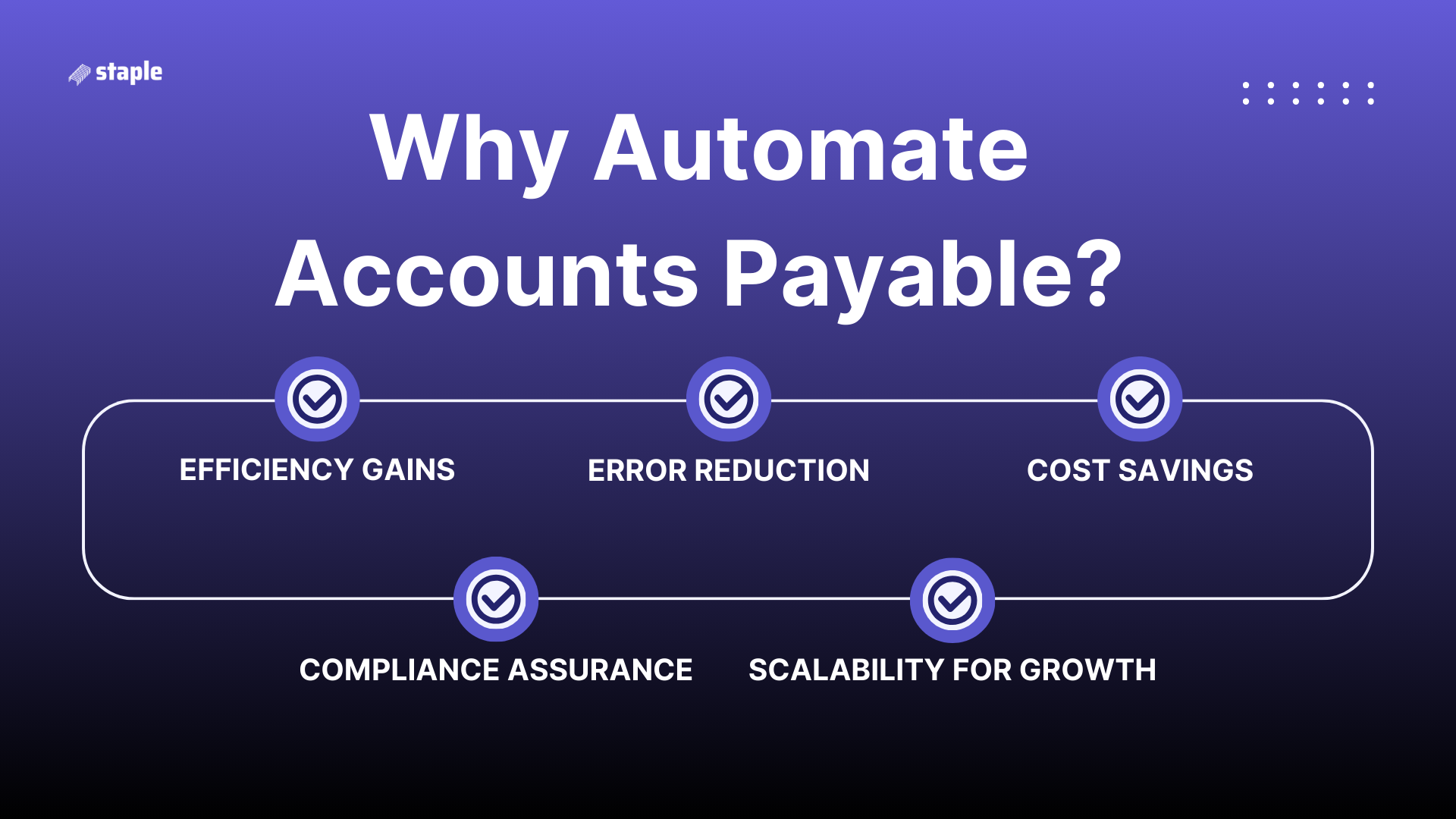
• Efficiency Gains By automating accounts payable your team is liberated from time-consuming manual tasks, significantly speeding up the processing cycle. This enables your finance department to concentrate on higher-value activities, such as developing financial strategies and nurturing vendor relationships. The outcome? More efficient operations, faster approvals, seamless payment cycles, and increased productivity and team satisfaction.
• Error Reduction Manual processes are prone to errors, such as incorrect data entry or duplicate invoices, leading to payment delays or disputes. Automating invoice processing with AI ensures accurate and reliable data capture and validation, significantly minimizing errors and making your accounts payable operations more efficient, seamless, and error-free.
• Cost Savings Businesses can drastically lower their operational expenses by removing printing, mailing, and storage costs. These savings can then be reinvested into growth-focused initiatives. Furthermore, automating accounts payable enables companies to capitalize on early payment discounts, further boosting their financial efficiency.
• Compliance Assurance Regional tax and regulatory requirements can be complex, especially for multinational organizations. AP automation solutions simplify compliance by integrating real-time validation of invoices against local regulations. Detailed audit trails and secure storage ensure businesses stay compliant and prepared for audits without manual intervention.
• Scalability for Growth As businesses expand, so do their invoice volumes. AP automation solutions are designed to scale effortlessly, handling increased demand without additional workforce. This ensures a future-proof accounts payable function that seamlessly supports your organization’s growth trajectory.
Best Practices for AP Automation Implementation
• Evaluate Current Workflows Evaluate your current accounts payable processes to identify inefficiencies and opportunities for improvement. Identify challenges like delays or recurring mistakes and document them to establish specific goals for automation.
• Select a Comprehensive Solution Not all AP automation solutions are created equal. Opt for a platform that integrates with your ERP system and supports custom workflows. Ensure the solution offers advanced features such as AI-driven invoice processing real-time compliance validation, and detailed reporting. Scalability and security should also be top priorities.
• Foster Stakeholder Collaboration Successful implementation requires buy-in from finance, procurement, and IT teams, host collaborative sessions to outline the benefits of automation and address potential concerns. Engaging stakeholders early ensures smoother adoption and builds a shared vision for the transition.
• Begin with a Pilot Programme Start small by automating a subset of your accounts payable processes, such as handling invoices from specific vendors. Use this phase to test the system, gather feedback, and refine workflows. A phased rollout minimizes disruptions and provides valuable insights for full-scale implementation.
• Provide Training and Support Equip your team with the skills needed to use the new system effectively. Organise training sessions demonstrating the software's features and highlighting its time-saving capabilities. Ongoing support and clear communication will help employees embrace the change with confidence.
• Monitor and Optimise Automation is not a one-time project; it requires continuous improvement. Regularly review system performance, identify inefficiencies, and update configurations to address evolving business needs. This iterative approach ensures sustained benefits and long-term success.
Key Benefits of Invoice Processing Automation
• Streamlined Operations Automating accounts payable simplifies workflows by automating data capture, validation, and routing for approvals. This reduces manual intervention, resulting in faster, error-free invoice processing and enhancing overall operational efficiency.
• Improved Supplier Relationships Timely payments facilitated by automation strengthen supplier trust. This creates better partnerships and can lead to more favorable payment terms or opportunities for collaboration, improving your company’s reputation in the supply chain.
• Fraud Prevention Automation systems in accounts payable detect anomalies and flag potential fraud by comparing invoices to pre-set rules and patterns. This proactive approach safeguards your organization from financial risks and reinforces internal controls, giving your team a sense of security and confidence in the system's capabilities.
• Advanced Analytics AP automation provides actionable insights through detailed reporting on spending trends, payment cycles, and operational bottlenecks. These analytics help businesses make data-driven decisions, improving efficiency and financial health.
Overcoming Challenges in AP Automation
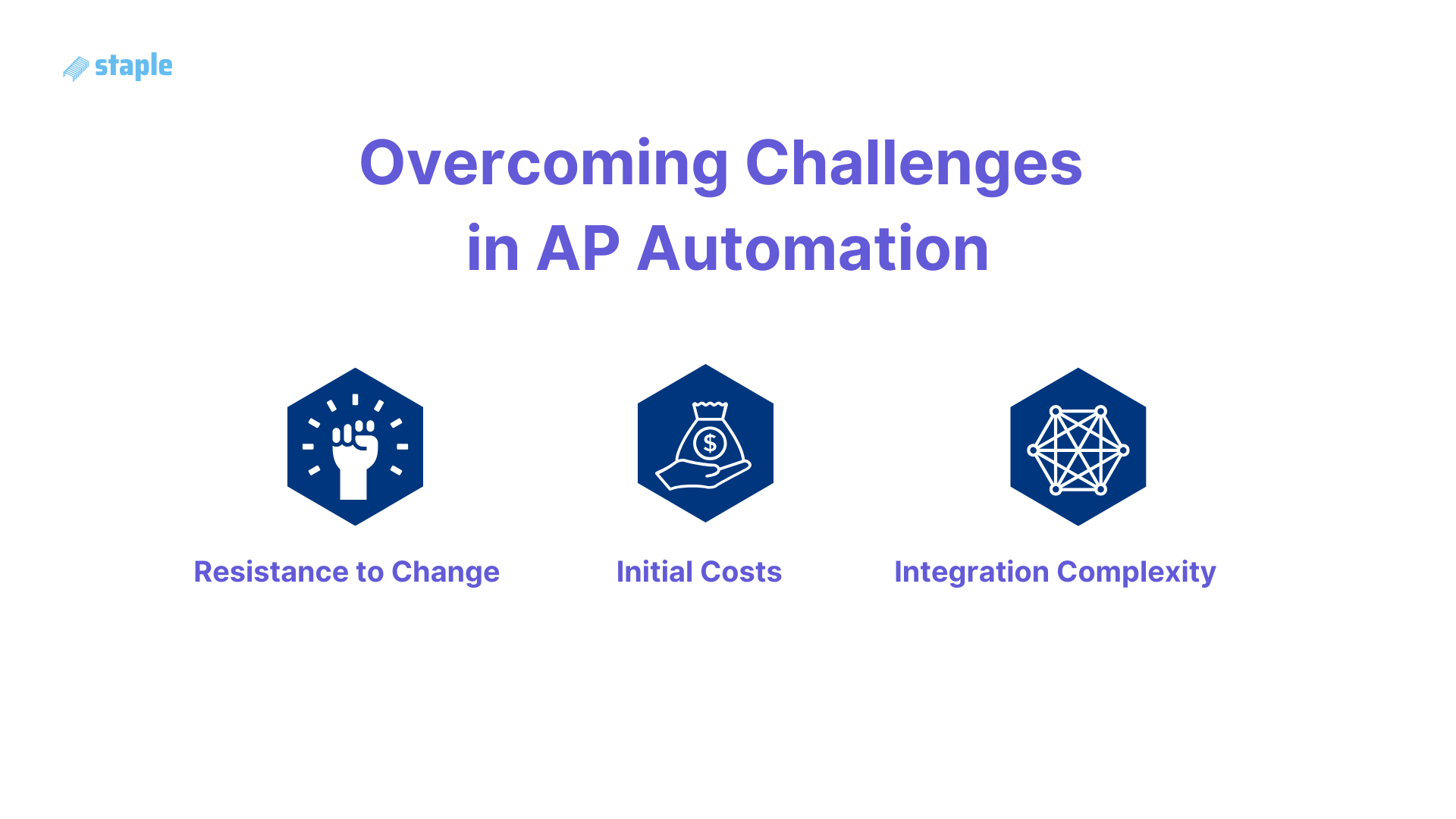
Like any significant transformation, accounts payable automation comes with challenges. Here’s how to address them:
• Resistance to Change Employees may hesitate to adopt new systems. Provide training sessions highlighting how automation reduces workloads and enhances job efficiency. Ongoing support and communication can alleviate concerns and drive acceptance.
• Integration Complexity Integrating AP automation with existing ERP systems can pose technical challenges. Work with experienced vendors who offer robust integration support to ensure seamless connectivity and minimal disruption to existing workflows.
• Initial Costs Although the upfront investment in automation may seem steep, highlight the long-term savings and efficiency gains to secure leadership's support and position automation as a cost-effective, future-proof solution.
Revolutionizing Accounts Payable with Staple AI
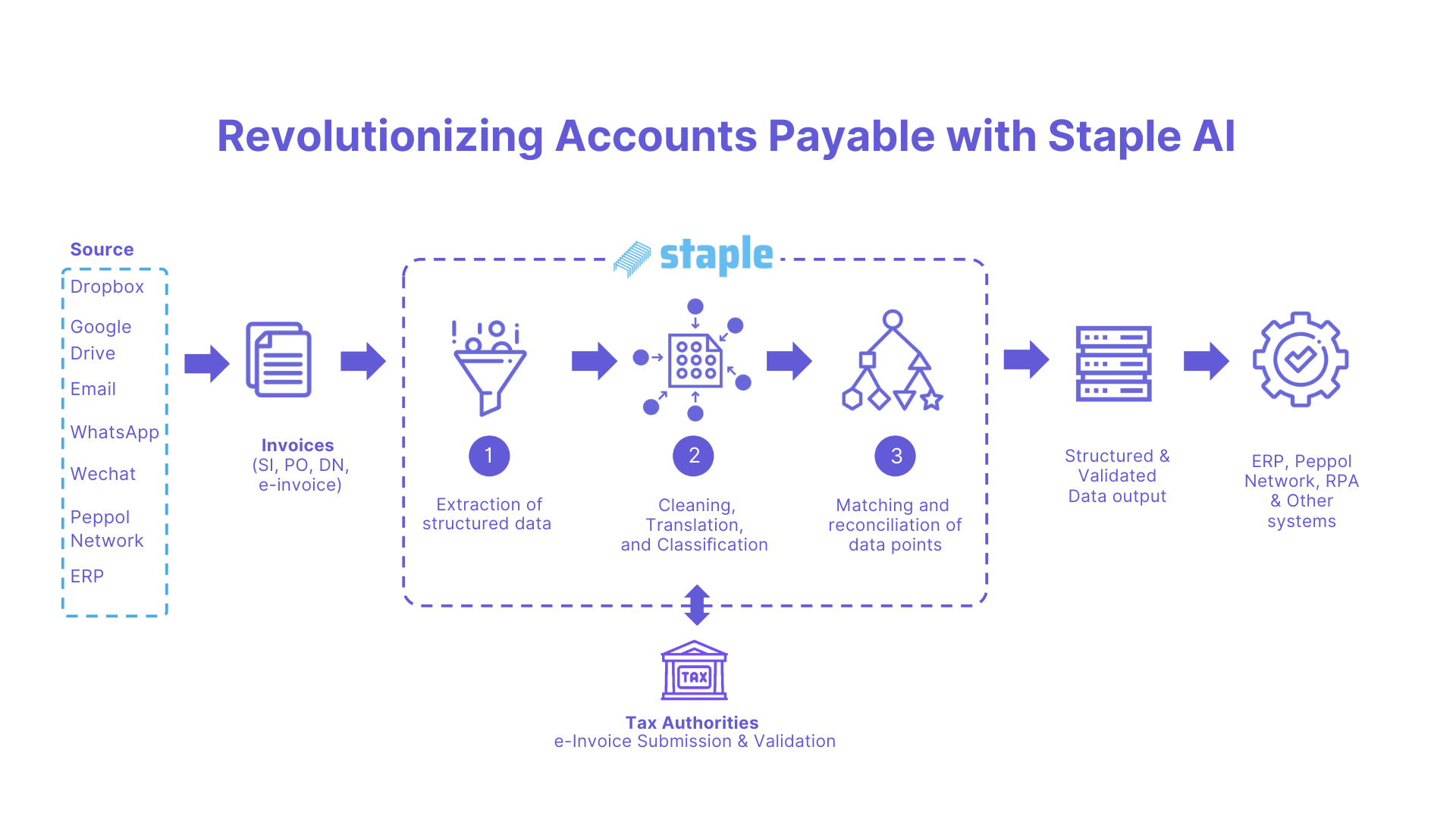
Staple AI transforms accounts payable automation equipping enterprises with powerful tools to streamline invoice processing and enhance operational efficiency. Organizations can focus on strategic priorities and reduce processing costs and errors using invoice processing automation
• Unmatched Accuracy with AI Staple AI uses cutting-edge artificial intelligence to extract and validate invoice data accurately. The platform accelerates processing times and ensures accuracy by reducing human errors and eliminating manual data entry. Thus, enterprises can trust that their invoice data is clean, consistent, and reliable, fostering better financial outcomes.
• Effortless ERP Integration Our platform integrates seamlessly with industry-leading ERP systems, allowing enterprises to enhance workflows without disrupting existing operations. This ensures a smooth transition from manual to automated processes, reducing downtime and improving team adoption. With minimal IT effort, your accounts payable function can quickly become more efficient and aligned with your business needs.
• Compliance and Data Security Staple AI is built to meet stringent compliance requirements across multiple regions, adapting effortlessly to local regulations. Our solution also employs robust encryption and security protocols to safeguard sensitive financial data. This ensures your organization remains compliant and protected against risks, offering you and your stakeholders peace of mind.
• Scalable and Flexible Solutions Whether managing hundreds or thousands of invoices, Staple AI scales to meet your business's demands. The platform’s customizable workflows allow enterprises to tailor automation processes to suit their needs. From small teams to global operations, our solution grows with your business, ensuring it remains a trusted partner as you expand. This scalability provides reassurance and confidence in the solution's ability to support your future growth.
• Data-Driven Insights Staple AI empowers enterprises with advanced analytics and detailed reporting tools. It lets you view payment trends comprehensively, identify bottlenecks, and uncover opportunities to optimize your accounts payable processes. These actionable insights support data-driven decisions, such as identifying cost-saving opportunities or improving payment cycle efficiency, helping your organization save time and improve financial performance.
Ready to elevate your accounts payable function to the next level? Contact Staple AI today to discover how we can transform your workflows.
Frequently Asked Questions
What does Staple AI do?
Staple AI is an AI-powered Intelligent Document Processor built for multinational enterprises. It automates the full document lifecycle , from ingestion and extraction to matching, reconciliation, and ERP integration , across finance, AP, compliance, and operations workflows.
Which industries does Staple AI serve?
Staple AI serves finance, banking, insurance, healthcare, manufacturing, retail, and logistics teams at multinational enterprises. Its platform is designed for high-volume, multi-format document environments across multiple countries and currencies.
How does Staple AI integrate with existing ERP systems?
Staple AI integrates with SAP, Oracle, NetSuite, Microsoft Dynamics, and other leading ERP platforms through pre-built connectors and APIs. Implementation typically takes four to eight weeks depending on system complexity.
What document types can Staple AI process?
Staple AI processes invoices, purchase orders, receipts, bank statements, contracts, KYC documents, medical claims, and custom forms. It handles structured, semi-structured, and unstructured formats from any channel , email, portal, EDI, or scan.
How do I get started with Staple AI?
You can request a demo at staple.ai. The team typically runs a scoped proof-of-concept before full deployment, so you can see real results on your own documents before committing.
Key Benefits of AP Automation
Automating accounts payable processes reduces invoice processing costs, speeds up cycle times, and significantly lowers error rates. Teams that implement AP automation consistently report improvements across all core metrics, from cost per invoice to exception handling rates.
The operational benefits extend beyond cost savings. Finance teams gain real-time visibility into payment status, outstanding liabilities, and vendor performance, which supports better cash flow management and more accurate forecasting.

.png)