
All-in-one Solution
One global integrated document processing platform
Document tamper checking, data extraction, translation, business rules verification and reconciliation, e-invoicing, integration with vendor platforms like TMCs, Staple delivers all of them in one platform, for any document, any language, any country. Delivers audit-ready, tamper-evident data, directly into your existing business systems.
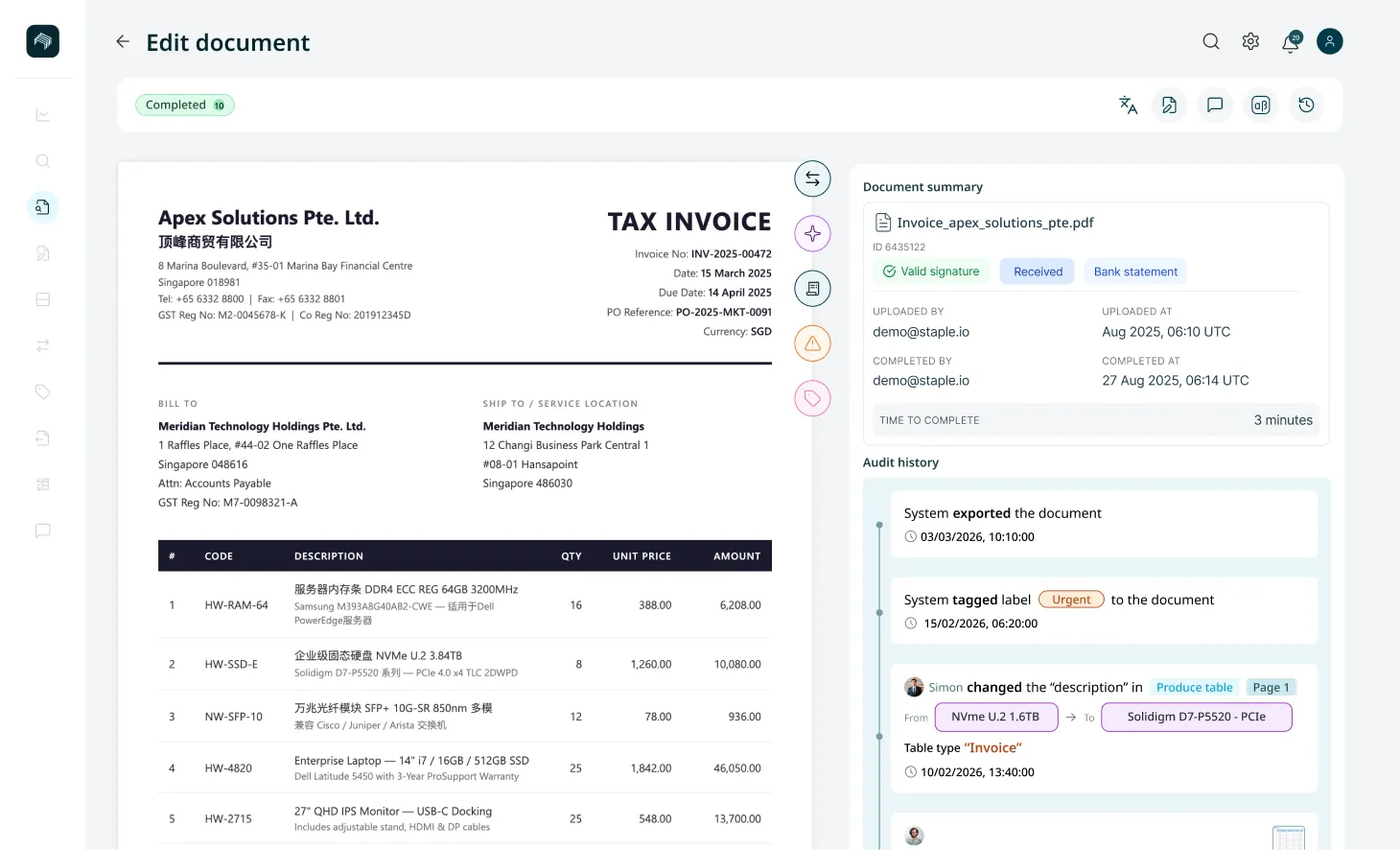
One document. Multiple tools. No audit trail
A finance team receives an invoice in a foreign language. It goes to a translation tool, then an extraction tool, then a matching tool, then an e-invoice validation platform, then a reconciliation system. Every handoff is a gap. Every gap is a compliance risk. When an auditor asks where a number came from, the answer spans five vendor dashboards, three data formats, and no shared record. The problem is not the individual tools. The problem is they were never built to work together.
- Each tool outputs data in its own format; by the time it reaches your ERP, the processing history is gone.
- Compliance coverage breaks at country borders: your extraction tool has no awareness of your e-invoice rules.
- When something fails, the audit trail stops at the edge of each vendor's system.
Every capability. One platform.
Document Verification
Before any data is extracted, Staple checks whether the document itself can be trusted. File metadata analysis and image anomaly detection identify tampering, forgery, or alteration at the container level.
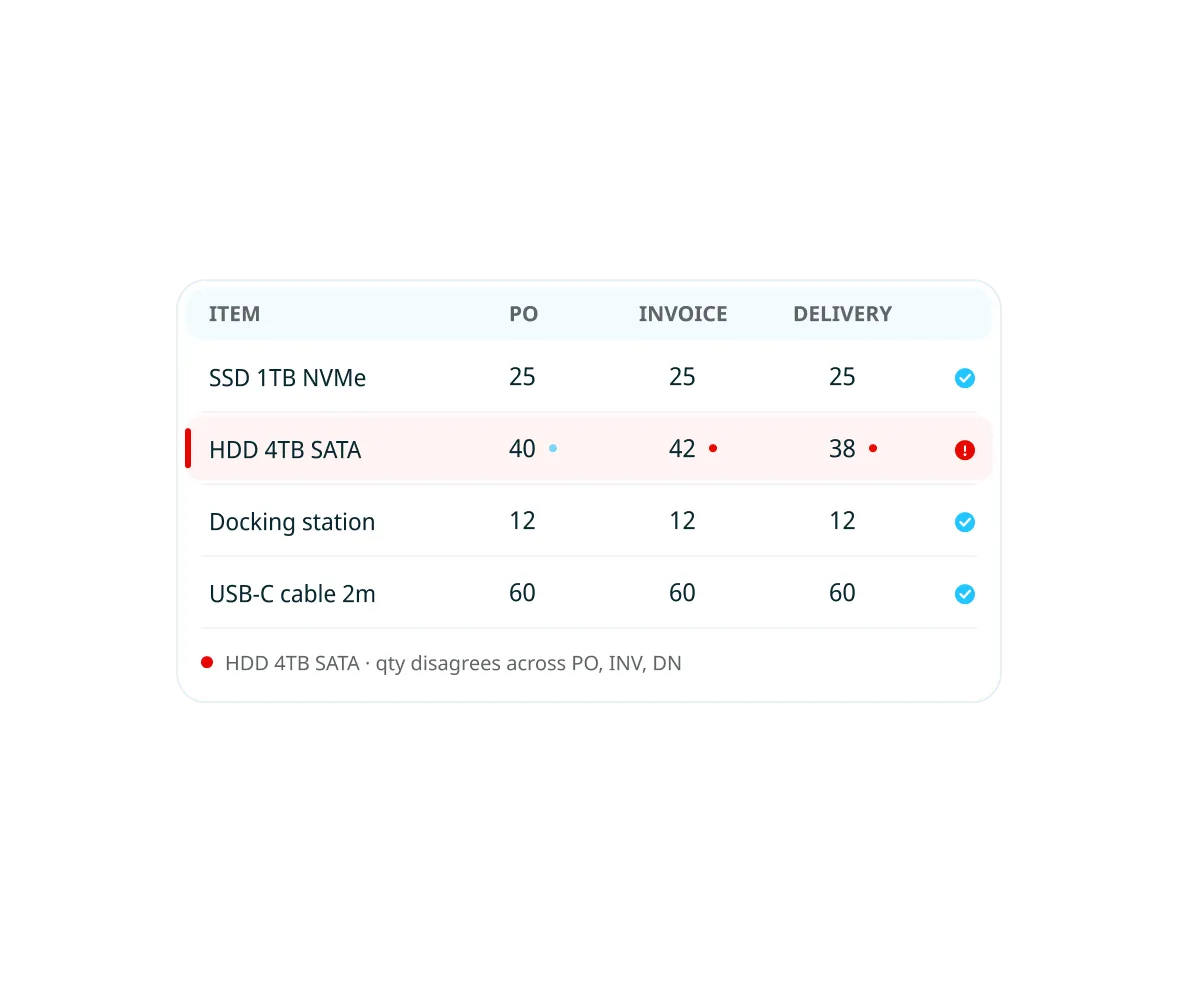
Data Extraction
Context-aware extraction reads meaning, not position. Header fields, line items, complex multi-level tables; extracted accurately regardless of layout, format, or language. No templates required.
Translation
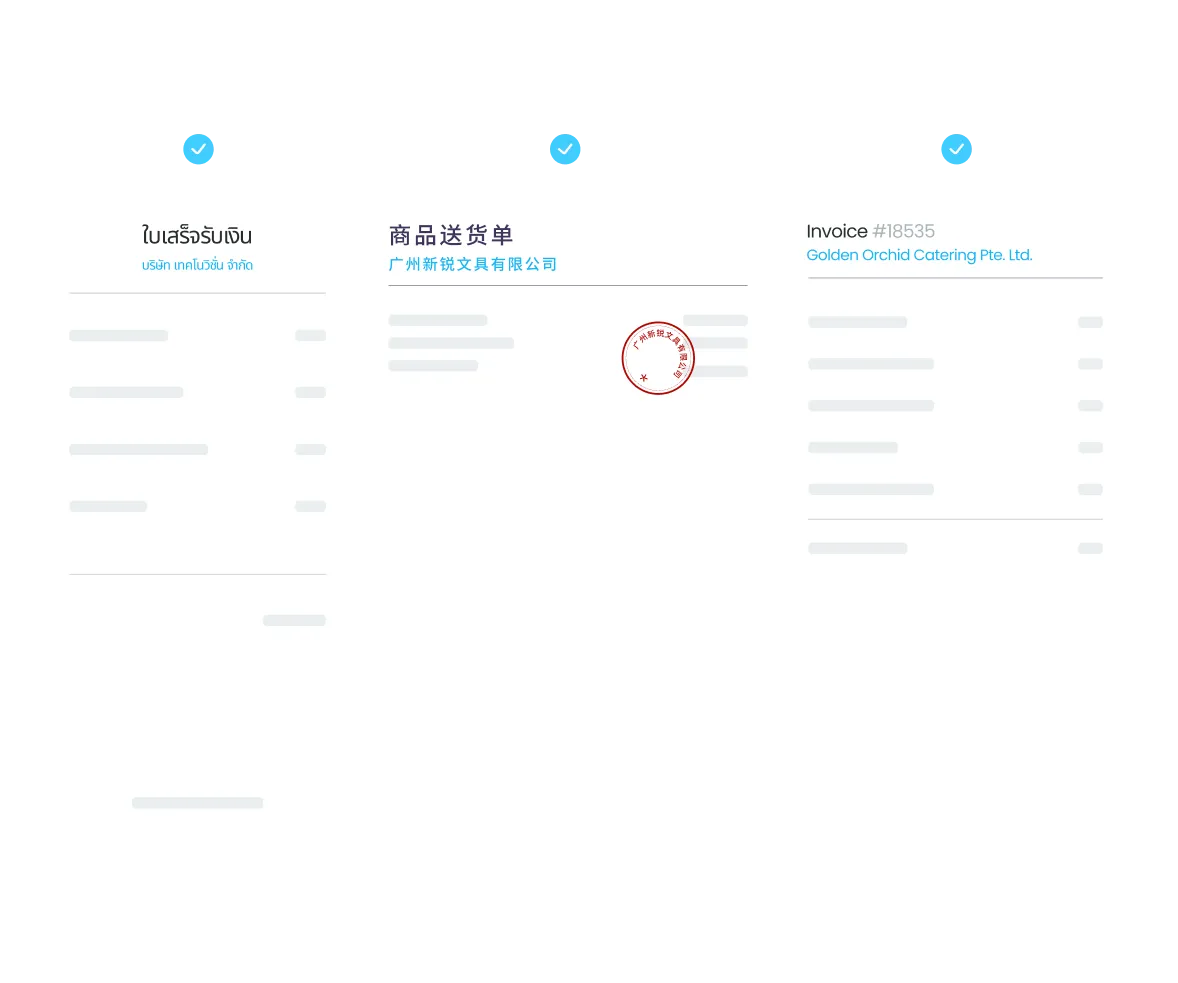
Every branch receives documents in a different language. Staple processes 300+ languages inside the platform; no country-specific translation tool, no separate step. Multilingual extraction and cross-language reconciliation in one workflow.
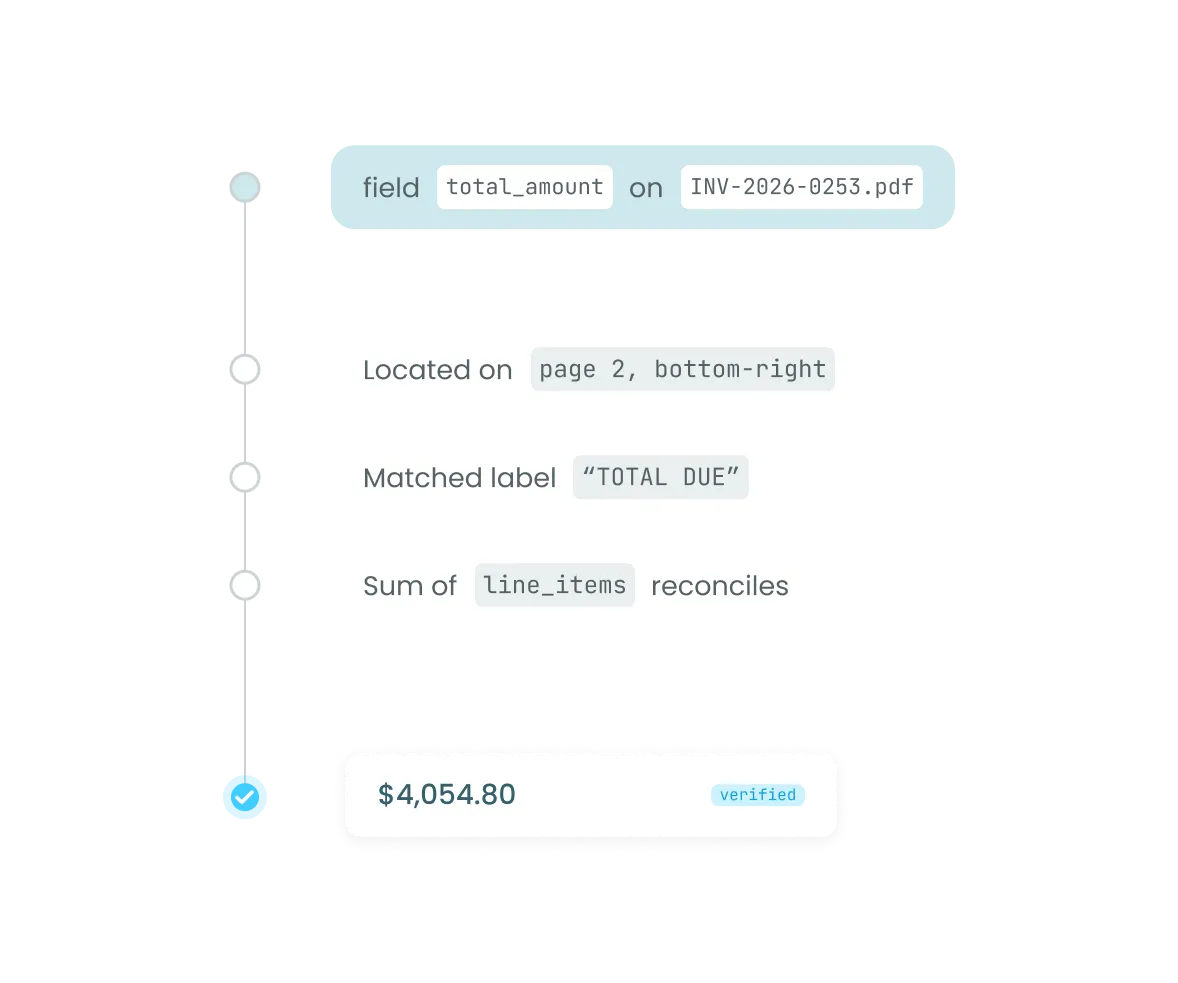
Business Rules Verification and Reconciliation
Extracted data is verified against your business rules and reconciled across sources (e.g., invoice against PO against GRN). AI contextual verification flags data falsification before anything reaches your ERP.
Global E-invoice Compliance
Different countries, different mandates. Your branches across Europe, LATAM, and APAC don't need a separate compliance tool per region. Staple covers e-invoice AP and AR flows across every country you operate in, unified under one schema, with country-specific rules and formats updated automatically.
From any source, into any system
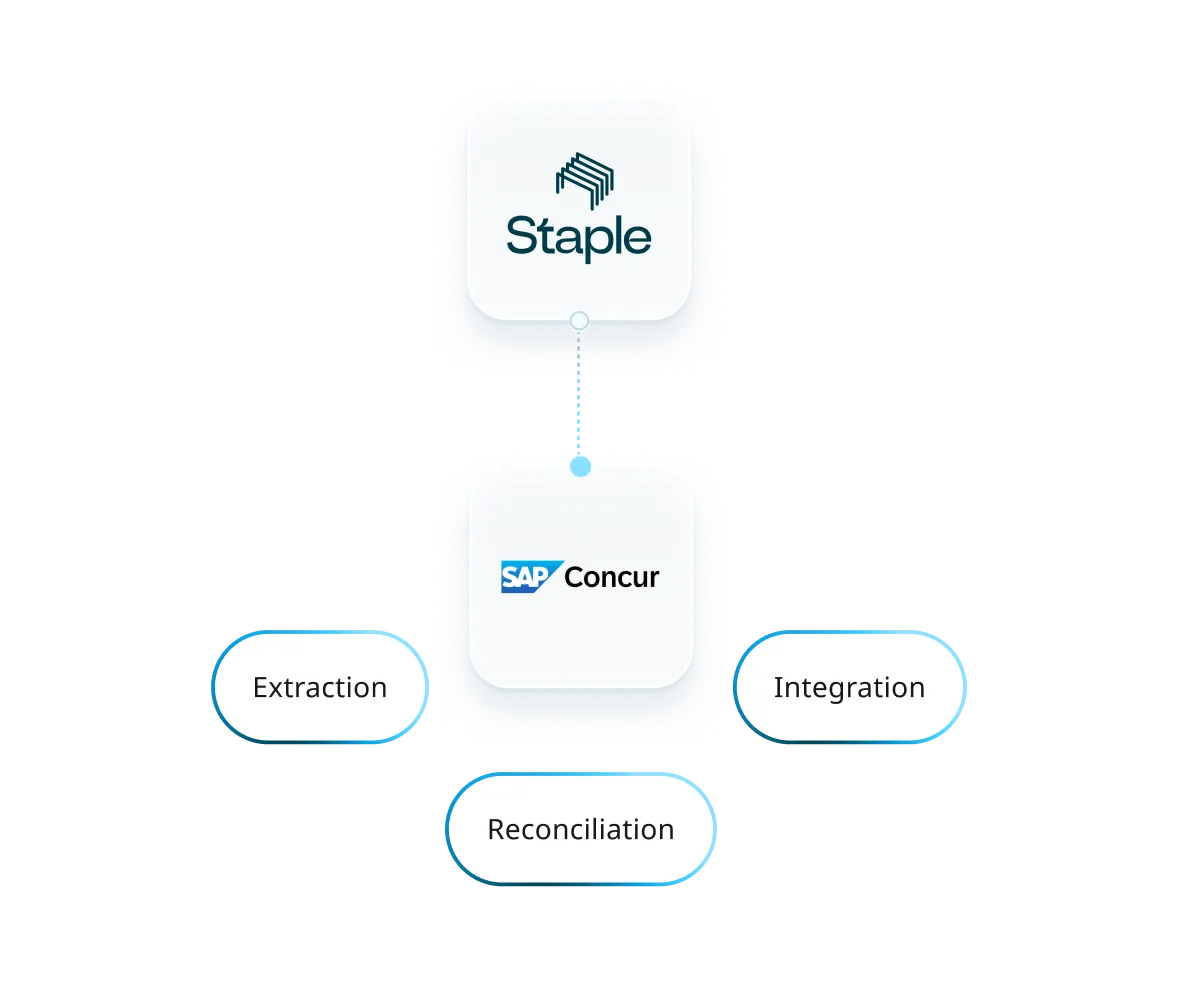
Documents reach Staple from email, cloud storage, messaging apps, your business systems via API, and external vendors like TMCs. Verified, audit-ready data leaves Staple for SAP, Concur, Oracle, Coupa, Yonyou, Xero, Investran, RPA platforms, and any downstream system via native AP. No middleware, no custom development, no disruption to the systems your teams already run.



Common questions
What does "one global document processing platform" actually mean for an enterprise?
It means replacing a fragmented stack of point solutions: OCR tool, e-invoice compliance platform, translation service, reconciliation system, exception spreadsheets with a single platform that handles document verification, extraction, translation, business rules verification, reconciliation, and e-invoice compliance in one workflow. It does not mean replacing the ERP, the AP system, or the compliance platform. It means replacing the extraction and verification layer that sits in front of all of them. Every downstream system receives consistent, verified, audit-ready data from one source, with one audit trail running across every document type and every country.
Why do enterprises end up running multiple disconnected document processing tools?
Enterprises accumulate document processing tools incrementally: an OCR tool for invoice scanning, a translation service for multilingual documents, a country-specific compliance integration when a new mandate arrives, a separate workflow for AML review, and spreadsheets for exceptions none of the tools handle cleanly. Each decision was rational at the time. The result is a stack no single team owns, that nobody can audit end-to-end, and that grows more expensive with every new country or document type added. The tools were not designed to connect to each other. The audit trail stops at the edge of each vendor's system.
What triggers document processing consolidation in a global enterprise?
Consolidation is rarely triggered by cost. The actual triggers are regulatory deadlines that expose gaps in the current stack, audit moments where a regulator asks for a field-level audit trail that cannot be produced, and data inconsistency that becomes undeniable during expansion into a new country. Enterprises living with a fragmented stack for years do not consolidate until one of these moments makes the status quo more expensive than change. The audit moment converts chronic operational pain into an active budget priority. Cost becomes a factor during procurement negotiations, not before.
What is document tamper checking and why does it need to happen before extraction?
Document tamper checking determines whether the document container itself has been altered before any data is extracted from it. File metadata analysis and image anomaly detection identify whether a document has been forged, modified, or substituted after issue. If tamper checking happens after extraction, the data has already been processed from a potentially compromised source. Checking the document first ensures that the extraction, verification, and audit trail that follow are built on a document that can be trusted. For invoices, KYC files, and compliance packs, this is the first layer of the audit trail.
What is the difference between data extraction and data verification?
Data extraction reads structured fields from an unstructured document: supplier name, invoice total, line items, account numbers. Data verification checks whether the extracted values are correct and consistent. Extraction can be accurate and the data can still be wrong: a falsified invoice figure extracts cleanly but fails verification when checked against the PO or master data. Staple AI applies both layers to every document: context-aware extraction that handles any format or layout, followed by AI contextual verification, business rules checks, and cross-source reconciliation that confirm the extracted data before it reaches any downstream system.
How does Staple AI handle e-invoice compliance across different countries without a separate integration for each?
Country-specific e-invoice mandates - different formats, different tax authority connections, and different submission requirements are absorbed into the platform and maintained by Staple. Regulations change, new mandates are introduced, and technical schemas update automatically without triggering a new IT project on the customer side. AP and AR e-invoice flows across Europe, LATAM, and APAC are unified under one schema. A global enterprise deploys once and extends to new countries within the same platform. No new vendor, no new integration, no separate audit trail.
What is a tamper-evident audit trail and why do regulators require it?
A tamper-evident audit trail is a sealed, unalterable record of what was extracted from every document, by which process, under which rules, at what time, and with what verification result; applied uniformly across all document types, use cases, and countries. Regulators do not accept partial records. When asked to demonstrate what was extracted and when, the answer must be complete regardless of whether the document was an invoice processed six months ago or a KYC pack processed last week. Running multiple tools produces multiple incompatible records. Staple AI embeds the unified tamper-evident audit trail at the field level across every document it processes.
How does Staple AI integrate with existing ERP and compliance systems?
Staple AI sits at the front of the existing technology stack, between document receipt and system input. It replaces the extraction and verification layer that was never built into those systems. Verified, audit-ready data is delivered into downstream systems: ERP, AP workflow, compliance platform, fund administration system via pre-built SAP modules and native API, in the structured format each system expects. No system replacement, no workflow rebuild. The ERP continues to operate as the system of record. Staple handles what those systems were never built to perform: taking unstructured documents and producing verified, audit-ready data.
See one platform handle your docs, across every country you operate in.
Book a 30-minute demo. Bring documents from multiple use cases and we will show you how Staple handles all of them on one platform.